Cigarette Island Park
A public park on left bank below bridge.
The "tail" of land on the River Thames. In 1935 the land was opened as a public park. Its name comes from a houseboat called "Cigarette" that used to be moored here. It is not strictly an island being bounded by the Thames and the River Mole and on the third side by Hampton Court Railway Station.
1606: Hampton & Hampton Court Ferries
1750: A wooden bridge was built. Gilbert White, Selbourne, - About 1747 -
the bridge at the Toy, near Hampton-Court, being much decayed, some trees were
wanted for the repairs that were fifty feet long without bough, and would
measure twelve inches diameter at the little end …
[ Fred Thacker in 1920 commented that this was
almost certainly for the first building, not repair, of the bridge]
1753: December 13th First Hampton bridge (1753-1778) opened. Constructed by Samuel Stevens and Benjamin Ludgator. An exotic seven-span timber bridge, it was a 20-foot wide road bridge and the largest Chinoiserie style bridge ever built (note the pagoda shaped roofs and curvilinear structure of the spans) -

First Hampton Court Bridge (1753-1778), 1753,
A Heckel, engraved C Grignion
A black and white version appears below
1758: A Description of The Thames, Binnell & Griffiths
HAMPTON Town has several very good Houses, a Free-school, and a Ferry to Moulsey Heath, or Hurst, famous for Cricket Matches, it being a beautiful, extensive, flat, and level Piece of Ground, or Common.
Canaletti’s drawing of the first Hampton Court Bridge (1753-1778) painted in 1794 -

First Hampton Bridge (1753-1778) in picture dated 1794

First Hampton Court Bridge(1753-1778)
1811: "A Treatise on Bridge Architecture", by Thomas Pope -
This [first bridge(1753-1778)] is a most beautiful and picturesque structure: the part which spans the river is constructed of timber, but the two abutments are built of stone: it furnishes a pleasing apearance in perspective from the adjoining shores of the river. The length is five hundred feet, and has seven arcs. The piers are cases of timber filled with stone. Barges of one hundred tons burthen pass through this bridge, by lowering down their masts; they are most commonly dragged by horses, which, on account of the shallow depth of water at certain times of the tide, are permitted to wade up the stream.
[The accompanying illustration is a drawing of the first bridge(1753-1788) in the above print of 1753, together with a cross section]

First Hampton Bridge(1753-1778), Thomas Pope, 1811
1778: The first bridge proved flimsy (no doubt the undulating design was not terribly functional for day to day use) and was rebuilt.
1790: Second Hampton Court Bridge(1778-1866), print by Thomas Rowlandson -

Second Hampton Court Bridge (1778-1866) in 1790, print by Tomas Rowlandson
1802: Picturesque Views on the River Thames, By Samuel Ireland -
FROM Hampton, the approach to the
bridge presents a favourable association of
objects for the pencil. The west end of the
old building, formerly the banqueting house,
breaks happily on the eye to complete the
scene, and it is from that point of view only
that this majestic pile can be introduced
into the landscape to advantage.
HAMPTON COURT bridge, which is of
wood, has a light and pleasing effect, and
was finished about twenty-five years since,
under the direction of a Mr. White of Weybridge ; the former bridge was so ill constructed as only to remain fit for use about
thirteen or fourteen years.

Second Hampton Court Bridge (1778-1866) in 1802, print by Samuel Ireland
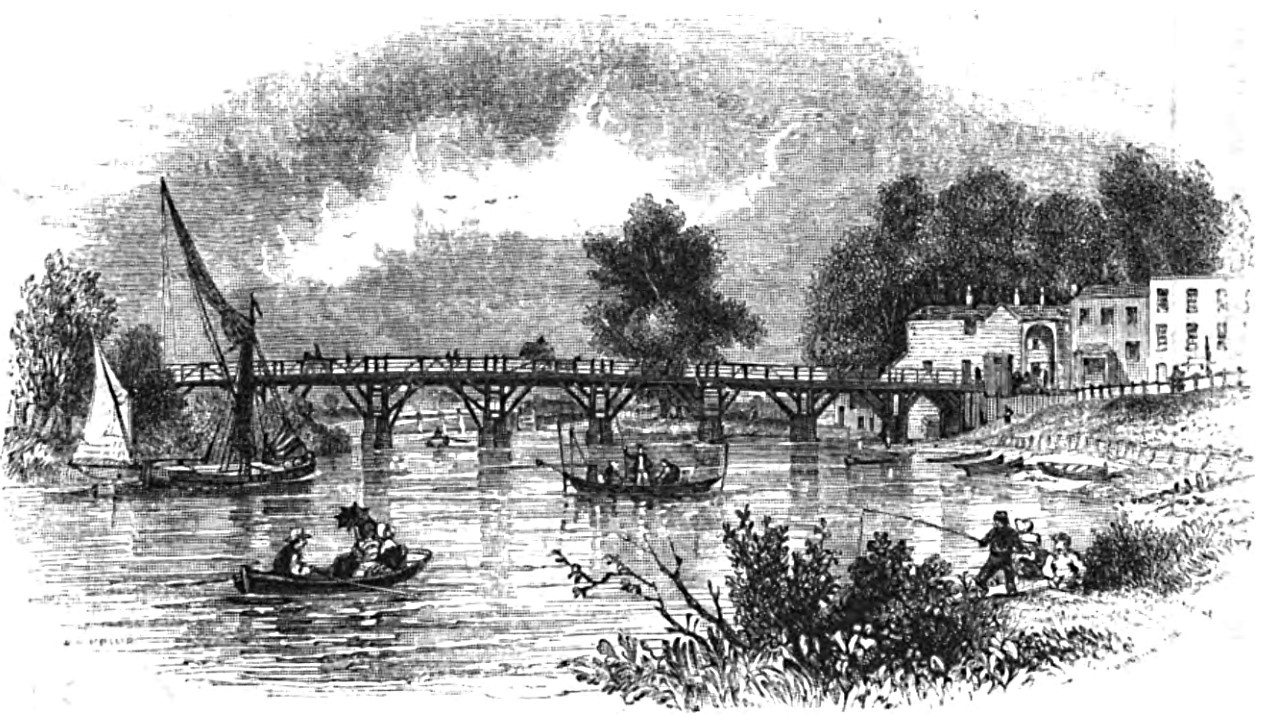
The second Hampton Bridge(1778-1866). I do not have a date for this picture-

The second Hampton Bridge(1778-1866)
1845: Picturesque Thames, Murray -
Here is a bridge over the Thames to East Moulsey,
erected in pursuance of an Act of Parliament passed in 1750, in favour of James Clarke, then lessee of the ferry under the Crown.
It is a light wooden structure of eleven arches.
The first sentence refers to the first bridge (1753-1778).
Murray in 1845 was obviously quoting something written about that bridge - but his drawing shows the second bridge (1778-1866)
which by my reckoning had ten arches.
Second Hampton Bridge, 1845, Picturesque Thames, Murray
Krause in 1889 describes a "particularly ugly structure of iron" and attaches a sketch - but this must be the second bridge (1778-1866) -

Second Hampton Court Bridge (1778-1866)
1834: Tombleson’s Drawing of Second Hampton Bridge(1778-1866) -

Second Hampton Bridge(1778-1866) in 1834, Tombleson
And I think this is the second Hampton Bridge (1778-1866) illustrated by John Leland in 1901 as "Old Hampton Court Bridge"

'Old Hampton Court Bridge' 1901
1864: The old bridge was described as “crazy,hog-backed, inconvenient and obstructive of the navigation”.
But this sounds more like the first bridge(1753-1788) than the second?
The third Hampton Bridge (1866-1933), a wrought iron girder bridge, was started, designed by E.T. Murray.
1866. Third Hampton Bridge (1866-1933) bridge opened

Under Hampton Court Bridge, 1874, Alfred Sisley
1875: Third Hampton Court Bridge (1866-1933), Henry Taunt -

Third Hampton Court Bridge (1866-1933), Henry Taunt, 1875
© Oxfordshire County Council Photographic Archive; HT2327

Third Hampton Court Bridge(1866-1933) in 1889
1897: Third Hampton Court Bridge (1866-1933), James Dredge -

Third Hampton Court Bridge (1866-1933), James Dredge, 1897
© Oxfordshire County Council Photographic Archive; D230189a
1896: Hampton Court, Francis Frith -

1896: Hampton Court, Francis Frith
1901: The Thames illustrated : a picturesque journeying from Richmond to Oxford, John Leyland -
We shall pause in our journeying at the bridge at Hampton Court, by the hospitable "Mitre".
The bridge [that would be the third bridge 1866-1933], a structure that disfigures the stream,
is the successor of others more picturesque, and of one more curious.
Truly a famous resort is this for fishermen and boating parties, for those who love to ply the line and pull the oar,
to lie in the summer sunshine where the green bank casts its shadow,
who delight to journey by coach or cycle along the road ... [ he goes on! ...]
...
Strolling down from Hampton Court to our boat which lies by the bridge, we leave behind us a whole world of
famous memories and a crowd of delightful places;
but it is to meet new interests and other beauties, to enter again upon the living enjoyments of the river,
marked by the laughter of boating parties, the long, strong, pulling of practised oarsmen,
and the placid pleasures of anglers in their punts ...
1907: Third Hampton Bridge (1866-1933), Watercolour -

The third Hampton Bridge (C)
1933: The fourth and current bridge was built to designs by Sir Edwin Lutyens
1955: Hampton Court, Francis Frith -

1955: Hampton Court, Francis Frith

Fourth Hampton Court Bridge (1933-), 2005 ©
Doug Myers

The Crossing Place, R Halfnight, 1890