1910: Staines in Thames Villages by Charles Harper.
Fred Thacker -
Cooper King thinks that in Roman times there were two bridges here
1228: A grant by the crown of two oaks from Windsor Forest for the repair of
Staines Bridge.
Fred Thacker – It was probably a rough structure of piles with transverse beams
1262: The Mirror of Literature, Amusement, and Instruction (1832) -
The first erection mentioned in the archives of Staines, was a wooden bridge, said to have been erected in the year 1262; it was constructed of piles of oak driven into the bed of the river and covered with planks.
1455:-
To John Brekenok, Thomas Frowyk and John Somerton for twelve years for the repair of the great bridge by Stanys & of a causey extending from the bridge to Egham -
1530: The townsmen of Staines sent the King a fresh Salmon and were
graciously rewarded with 20 shillings.
1549: The inhabitants petitioned the Privy Council against a Royal mandate -
to pluck up the common bridge for the safeguard of the realm as they allege from enymyes
The petition stated that demolition -
is and wilbe to thutter undoing and destruccon of the hoole towne and countrie thereaboute; and the bridge is yet staied part of it because they had ventured to send out scouts to descry if any Army be coming that way.
1593: Norden’s Map shows
a Mill against the bridge on the Right bank, driven probably by the Colne.
1610: Camden -
Stanes, in the Saxon tongue Stana , offereth it selfe to our sight, where Tamis hath a wooden bridge over it. This name it tooke of a meere-stone [boundary stone] heere in times past set up to marke out the jurisdiction that the Citie of London hath in the river.
1641: John Taylor, Last Voyage –
As farre as above Stanes … the river Thames is by the care and providence of the Lord Mayor well conserved and kept from impediments of Stops, Weares, Sand beds & other hindrances of passages of eyther Boates or Barges; and from Stanes to the furthest part almost there is no stoppage (but only Weares, which weares have Lockes to open and shut for the passing to and fro of all manner of vessells (passable through from London to Oxford); betwixt which cities the barges doe draw up nineteene of those lockes with engines (like capstanes which are called Crabbs.
1669: Cosmo III’s Travels -
… wooden bridge over the Thames, which is here very shallow a mile from Egham.
1699: Ogilby, Traveller’s Guide –
Wooden bridge maintain’d by a toll on Barges.
1738: A Voyage up the Thames, Weddell -
We arrived safe at Stains about ten in the forenoon, and went to a house of entertainment,
where everything appeared in a very good taste:
breakfast was brought, consisting of chocolate, coffee, ham, cheese, ale and wine: ...
(in a company of six men it is natural to expect at least one or two who can breakfast on beef and ale!)
1758: A Description of The Thames, Binnell & Griffiths
... the Market Town of Staines, in the County of Middlesex, is pleasantly situated by the Thames, over which is a wooden Bridge, which leads to Esher [Egham?] in Surry, and is the high Road from London to the western Parts of England.
1792: Picturesque Views on the River Thames, By Samuel Ireland -

Staines Bridge Ireland, 1792
FROM the Saxon word stana, or stone, the town of Staines most probably derived its
appellation.
To the notice of the curious, it has at present little to recommend it, except
the tower of the church, which is reported to be a design of Inigo Jones, who
resided some time in this town.
ITS ancient decayed wooden bridge, I am
happy to find, is shortly to be removed, and
will receive an elegant substitute of stone,
from a design of the ingenious Thomas
Sandby, Esq. R. A. whose plan has been
already approved by the Commissioners.
To that gentleman, whose known urbanity
renders him ever willing to communicate
that scientific information, with
which he is so amply stored, I am indebted
for the annexed sketch.

Staines Bridge Sketch, Sandby, Samuel Ireland, 1802
THE new bridge will stand nearly in the
direction of the old one, and the building on
the right, on the Surrey side, is intended (if
approved of) as a spacious inn.
The bridge
confists of three eliptical arches, the center[sic]
fixty feet in width, and the two side ones
fifty-two each. The building of this bridge is contracted for at the sum of eight thousand
four hundred pounds, and is intended to be begun early in the spring.
1791: Act of Parliament authorising the 1794/5 bridge
1794: The Mirror of Literature, Amusement, and Instruction (1832) -
from [1794 to 1832],
there have been not less than four new bridges in succession, and on nearly the same site.
In the year 1794 and 1795, a new bridge, of three semicircular arches of stone,
from the design of the celebrated Paul Sandby, was erected,
but, from some defect in its construction, it lasted only five years.
[ There may be a confusion between Paul Sandby, map maker and water colourist
and his older brother Thomas Sandby, engineer and architect. ]
This 1794/5 stone Staines bridge was built a little below the old bridge.
1802: Samuel Ireland's View of the 1794 Stone Staines Bridge -

Staines Bridge Samuel Ireland, 1802
1802: William Tatham's report on the Navigation of the River Thames, Staines Bridge
1802: Letters from England By Manuel Alvarez Espriella (attributed to Robert Southey) -
Monday, April 26th [1802]
... At Staines we crossed the Thames, - not by a
new bridge, now for the third time built, but over
a crazy wooden one above a century old.
We inquired the reason, and heard a curious history.
The river here divides the counties of Middlesex
and Surrey ; and the magistrates of both counties
having agreed upon the necessity of building
a bridge, did not agree exactly as to its situation ;
neither party would give way, and accordingly
each collected materials for building a half bridge
from its respective bank, but not opposite to the
other. Time at length showed the unfitness of this,
and convinced them that two half bridges would
not make a whole one; they then built three
arches close to the old bridge : when weight was
laid on the middle piers they sunk considerably
into an unremembered and untried quicksand, and
all the work was to be undone.
In the meanwhile
an adventurous iron bridge had been built
at Sunderland, one arch of monstrous span over
a river with high rocky banks, so that large ships
could sail under. The architect of this work,
which was much talked of, offered his services to
throw a similar but smaller bridge over the
Thames. But, alas! his rocky abutments were
not there, and he did not believe enough in
mathematics to know the mighty lateral pressure
of a wide flat arch. Stone abutments however
were to be made ; but from prudential considerations
the Middlesex abutment, of seeming solidity,
was hollow, having been intended for the
wine cellar of a large inn ; so as soon as the wood frame work was removed, the flat arch took
the liberty of pushing away the abutment - alias
the wine cellar - and after carriages had passed
over about a week, the fated bridge was once
more closed against passage.
I know not how these iron bridges may appear to an English eye, but to a Spaniard's they are utterly detestable.
The colour, where it is not black, is rusty, and the hollow open spider work, which they so much praise for its lightness, has no appearance of solidity.
Of all the works of man, there is not any one which unites so well with natural scenery and so heightens its beauty as a bridge,
if any taste, or rather if no bad taste, be displayed in its structure.
This is exemplified in the rude as well as in the magnificent ; by the stepping stones, or crossing plank of a village brook, as well as by the immortal works of Trajan :
but to look at these iron bridges which are bespoken at the foundries, you would actually suppose that the architect had studied at the confectioner's,
and borrowed his ornaments from the sugar temples of a dessert.
It is curious that this execrable improvement, as every novelty is called in England, should have been introduced by the notorious politician, Paine,
who came over from America upon this speculation, end exhibited one as a show upon dry ground in the metropolis.
The old wooden bridge can be seen the other side of the stone bridge. It was just as well! Because the 1794 stone bridge did not last. The central arch almost immediately cracked, owing to poor foundations. The old bridge (which had been sold) was repurchased and used again till 1803.
Tracts on Mathematical and Philosophical Subjects, 1812 -
[In] about the year 1800, the stone bridge erected over the Thames, at Staines, gave
way.
On this occasion the magistrates of the counties of
Middlesex and Surrey came to a resolution to erect an iron
bridge there, on the abutments of the stone bridge, the piers
of which had failed ; and Mr. Wilson, the agent of Mr. Burdon, was employed for this purpose.
He accordingly undertook
the construction of an iron arch of 181 feet span, with
16½ feet rise or versed sine; the arch being the segment of a
circle.
In this bridge the ribs were similar to those of Wearmouth :
but instead of having the blocks, of which the ribs
are composed, kept together by worked iron bars, let into
grooves in their sides, the rings of the ribs were cast hollow,
and a dowel was let into the hollow ring at each joint; so that
the two adjacent blocks were fixed together by this dowel,
and by keys passing through the rings. The ribs were also
connected transversely by frames, instead of pipes as in the
Sunderland bridge. The haunches were filled with iron
rings, and the whole was covered with iron plates.
It is to be noted, that an iron arch, in small blocks, is not
set up after the manner of a stone one, by beginning at the
abutments, and building upwards; but is begun at the top,
and continued downwards; it being easier to join the stone
to the iron, than to cut the iron at the top, if it should not
fit. It is somewhat remarkable, therefore, that when these
ribs were put together, and before they joined the masonry,
it was so nicely balanced, and its parts were so firmly locked
together, that after all the supports were taken out, except
those next the abutment, the whole was moved by a man,
with a crowbar under the top, and it seemed to have little
tendency to push the abutments asunder.
This, however,
turned out unfortunately not to be the case. The centring
was taken away, and the bridge was opened for the use of the
public, about the end of the year 1801, or beginning of 1802.
At first it seemed to stand firm, and the public were much
pleased with its light and elegant appearance.
But in a short
time it was found that the arch was sinking ; and soon after
it had gone so much, that it was obliged to be shut up, and
the old bridge opened again.
The sinking of the arch broke
several of the transverse frames, and many of the radii at
the haunches ; which left no doubt that the abutments had
given way. But on examination there appeared no visible
sign of such failure : there was not a crack in the masonry,
nor had they gone out of the upright.
After much investigation
however, it appeared that the whole masonry of the
abutments, to the very foundation, had slidden horizontally
backwards, still preserving the perpendicular, or upright
position. The failure took place in the south abutment,
which was supposed to be owing to a cellar, that had been
made in it.
The inhabitants of Staines therefore, by the advice
of an engineer whom they consulted, had this abutment
strengthened : but no sooner was this done, than the north
one failed : and they had intended to strengthen this also ;
but their funds being nearly exhausted, they came to the resolution
to take the whole down, and erect a wooden bridge
in its stead.
1803: The Mirror of Literature, Amusement, and Instruction (1832) -
A very elegant bridge of one arch, of 180 feet span, of cast iron, from the design of Mr. Thomas Wilson, the architect of the celebrated bridge over the river Weir, at Sunderland. The design was attributed to the noted author of the Rights of Man; but the arch designed by him was cast in the year 1790, by Messrs. Walkers, at Rotherham, whence it was brought to London, and erected at the bowling-green of the Yorkshire Stingo public-house, where it was exhibited to the public; Paine not being able to defray the expense, the arch was taken down and carried back to Rotherham; part of it was afterwards used in the Sunderland bridge, and part, it is supposed, in the Staines bridge. This last, like its immediate predecessor, was not destined to last long, for it had scarcely been opened one month, when it was found necessary to close it to the public, the arch having sunk in a very alarming degree. His late Majesty King George the Third was said to have been among the last to pass over it. In this emergency the late Mr. Rennie was consulted, who pronounced the bridge altogether dangerous, in consequence of the weakness of the abutments. No alternative remained but to remove the iron bridge entirely, and patch up the old wooden bridge until a new one of wood was built. That bridge, which is the present old bridge, continued to stand, with various repairs and alterations, until the year 1828
1807: A fourth wood and iron bridge was built
(and the old wooden bridge was demolished).
1814: Owen’s view of the fourth Staines Bridge -

Staines Bridge Drawn by S. Owen. Oct. 1, 1814.
1821: Arnald’s view of the fourth Staines Bridge -

Fourth Staines Bridge from
the engraving by W B Cooke
after the painting 'Stone at Staines' by G. Arnald, A.R.A. Novr 1, 1821
[the full engraving is a view of the London Stone, see below]
1828: Westall’s view of the fourth bridge –

[Fourth] Staines Bridge. W. Westall A.R.A. delt. C. Bentley sculpt
Published 1828 by R.Ackermann, 96 Strand, London
1828: The Mirror of Literature, Amusement, and Instruction (1832) -
when, in consequence of the decay of the piles [of the old wooden bridge], and the continual heavy expenses required to uphold it, the Commissioners determined to build a new one of more durable materials. Messrs. Rennie were therefore applied to for designs, and a bill was brought into Parliament to authorize the Commissioners to raise funds. The works were commenced in the spring of 1829, and on the 14th of September following the first stone was laid by their Royal Highnesses the Duke and Duchess of Clarence (their present Majesties). Since then, the works have been carried on to their present completion under the direction of Mr. G. Rennie and Mr. Brown, the superintendents, and Messrs. Jolliffe and Banks, the contractors.
1830: The Westminster Review -
The bridge over the Thames at Staines is a notable instance of this perversity in brute matter.
About thirty years ago there was, at this place, a wooden bridge, which was condemned,
and a stone bridge of three arches was built just below it.
This was scarcely finished, when the piers sunk, and the arches cracked;
luckily in time to stop the removal of the condemned wooden bridge, which,
it was discovered, might be trusted till another new bridge was completed.
It was now taken for granted that the bed of the river could not support piers,
and an iron bridge of one arch, with comely stone abutments, spanned the Thames with infinite grace.
But this again had scarcely been opened, when, under the pressure of a herd of cattle,
the arch stove-in the Middlesex abutment, and again, luckily, in time to stop the removal of the wooden bridge,
which, it was again found, would serve till the completion of a third new edifice.
This was a wooden bridge with an iron railing; of which the piles rotted with a celerity quite edifying:
and now, after repeated repairs, this is condemned in its turn, and another stone bridge is in progress,
and nearly completed, which will of course last till Doomsday.
1832: Fifth Staines Bridge begun in 1829 was opened on 23rd April by King William IV.
Brayley – “two hundred yard higher than its immediate predecessors,
covering perhaps the site of the original bridge”.
Fred Thacker says the bridge of 1828 was the present bridge -
however there is something here that I cannot reconcile.
There appear to be two bridges!
The present bridge seems to me the same as the
1832, 1859, 1883, 1890, 1907 and 1999 pictures.
But there is another bridge shown in 1836 (a very clear picture)
and matched in 1839 (a less clear picture.
SO - I have misunderstood something!
[If you can explain
leave a message for me!]
1832: The Mirror of Literature, Amusement, and Instruction. SATURDAY, MAY 26 -

Staines New Bridge 1832
This handsome structure has lately been completed, and was opened on Easter Monday last,
April 24, by their Majesties and the Court passing over with suitable ceremony.
This was a gala day for Staines and its vicinity;
for, independently of the enthusiasm awakened by the visit of the popular Sovereign,
the completion of so useful and ornamental a fabric must have been an occasion
of no ordinary interest to every inhabitant of the district.
[The New Staines Bridge] consists of three very flat segmental arches of granite.
The middle arch of 74 feet span, and the two side arches of 66 feet each;
besides two side arches of 10 feet each for the towing-paths,
and six brick arches of 20 feet span each, two on the Surrey side,
and four on the Middlesex side, to allow the floods to pass off.
The whole is surmounted by a plain, bold cornice, and block parapet of granite,
with pedestal for the lamps, and a neat toll-house.
The approaches to the Bridge on either side form gentle curves of easy ascent.
The cost of the Bridge and approaches has been about £41,000.
The appearance of the whole is very light and elegant.
This is owing chiefly to the slight dimensions of the piers,
which are smaller in proportion to the span of the arches they support
than those of any other bridge in England;
but this slight appearance does not, we understand,
detract in any degree from their strength, or from the durability
of the superincumbent structure.
1836: But the Eton Book of the River shows this picture of the finish of an Eton v Westminster School race. It specifically says that the picture is at Staines Bridge, and it seems to me a different bridge. But this is not the Sandby bridge of 1794-1799. So what is it? It looks like a cross between the two stone bridges -

ETON BEATING WESTMINSTER
Staines Bridge
May 12th 1836. (A Picken)
This race took place at Staines on Thursday, May 12.
The distance rowed was from Staines Bridge to Penton Hook and back about four miles
altogether.
Lord Orford and Captain Ackers, of the Blues, were appointed Umpires.
About four o’clock the Etonians appeared in rowing trim in the Victory,
a new boat built by Archer, of Bishop’s Walk, Lambeth.
The young gentlemen of Westminster came to Staines in a new eight, called the Fairy Queen,
built of fir, expressly for the occasion, by Noulton and Maynard, the well-known watermen,
the former taking the lines for his patrons.
It was evident, even at a cursory glance, that the Etonians had the decided superiority in
weight and strength, and betting was in their favour.
Westminster won the choice of station, and they took the south pier of Staines Bridge.
Previous to starting, it was agreed upon that no fouling should take place until
half a mile of the distance had been rowed.
On going away from the bridge the Westminsters went in advance,
which position they kept for about a quarter of a mile, Eton pressing them closely.
Noulton had by this time steered the Fairy Queen over to the course the
Etonians were pursuing, and he bored them so closely in shore that they were obliged
either to foul the Westminsters or go into the bank.
A foul consequently took place, which lasted five or six minutes,
ending in the discomfiture of the Fairy Queen, who had her rudder struck off,
an oar broken, and was turned completely around.
The Etonians went away with a cheer, but the Umpires,
considering that an infringement of the agreement had taken place,
called them back to a fresh start, which they immediately complied with.
At six o’clock they started from the bridge a second time, with an understanding
that each boat should keep its own side of the water for half a mile.
The Fairy Queen again took the lead, which she held for about three-quarters of a mile,
when the Etonians came upon them, and some smart fouling was the result.
Eton at length cleared, and showed the way down the stream.
In rounding the distance boat they were close together, and immediately after
doubling the station punt the Westminsters caught them on the starboard quarter,
which nearly put the Victory into the bank stern up.
The Etonians, however, shortly cleared themselves from this awkward situation,
and once more went in advance; and notwithstanding they were occasionally
bumped by the Fairy Queen in working up against the stream,
they maintained the lead, ultimately winning by several boat’s lengths.
The match proved a treat throughout, by the spirited and gallant manner
in which it was contested by both parties.
1839: Trotter’s view of Staines Bridge. This is detail from the 1839 view of the London Stone - below.

[detail from]
Staines Bridge Middlesex C. Marshall. J. Henshall.
London, Simpkin, Marshall & Co., C. Tilt and the
Proprietors, 1 Cloudesley Terrace, Islington. A Asher, Berlin
1859: The Thames, Mr & Mrs Hall
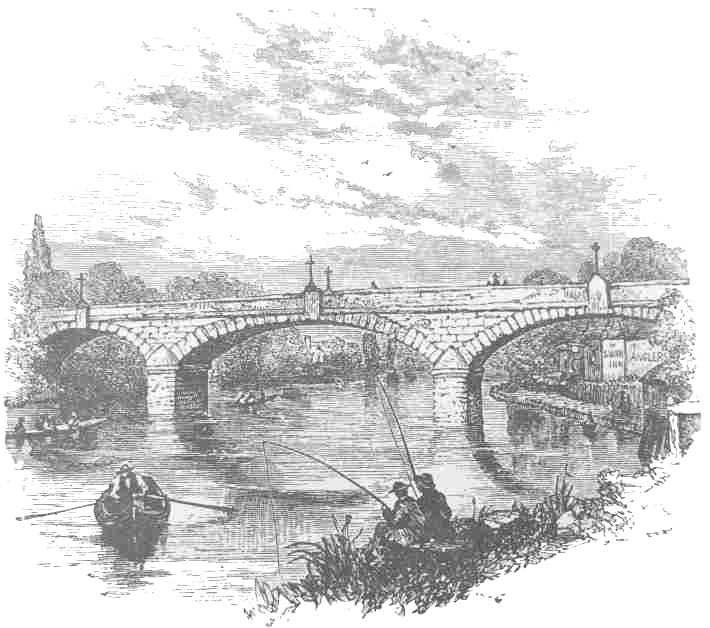
STAINES BRIDGE
A handsome bridge connects it with the county of
Surrey, from whence there are direct roads to Windsor, Egham, and
Chertsey. This bridge was erected in 1832, George Rennie being the
engineer. It was opened in state by their Majesties King William IV. and
Queen Adelaide.
"The bridge consists principally of three extremely flat, segmental arches of
granite, the middle arch being of seventy-four feet span, and the lateral ones
sixty-six feet each: there are also two
adjoining semicircular arches, each ten feet in the span, for towing-paths.
Besides these, there are six brick arches of twenty feet in the
span, two on the Surrey side and four in Middlesex, to admit the water
to flow off during land-floods."
Our engraving is taken from "above bridge", and underneath one of the arches
is seen the comfortable little
inn, "The Swan", well known to all brethren of the craft, and especially
those who frequent "Staines Deep", *
* "Deeps" are portions of the river staked and otherwise protected, in order to prevent the use of
nets, and so to facilitate the sport of the angler, for whose especial benefit they are formed. Usually
old boats are sunk in these deeps: the fish collect about them, and cannot be removed by any "coarse"
process.
The deeps between Staines and Richmond have all been formed at the expense of the Corporation of London:
to them, therefore, Thames anglers have long been, and will long be, largely
indebted. To the angler, at all events, the transfer of power from the Lord Mayor to the Commission
is a subject of regret; and he is a recreant brother, who, obtaining a day's sport in any of the "deeps"
will fail to repeat the prayer of the boundary stone — "God preserve the City of London".
where, during the autumn months, abundance of large roach will usually reward the pleasant toil of the
punt-fisher.
Staines was the site of one of the earliest bridges in England. The
Roman road to the west crossed the Thames here, and the Roman
station at this place is called in the Itinerary of Antoninus, Pontes, so
that even then there was a bridge across the river. The Roman bridges
in England seem to have been most commonly wooden, supported on
stone piers. Perhaps the remains of the latter may have given the
place its name.
1870: Staines Bridge, Henry Taunt -

Staines Bridge, Henry Taunt,1870
© Oxfordshire County Council Photographic Archive; HT1460
1890: Staines Bridge, Francis Frith -

1890: Staines Bridge, Francis Frith
1901: The Thames Illustrated by John Leland -
It is two miles and a half from Laleham to Staines Bridge, the grey granite structure of Rennie,
a very pleasing and winding course, amid woods and fields, with rooks winging their way above,
or skylarks trilling where the eye cannot follow.
From the river itself we see little of the old town of Staines, which is now a thriving place,
with manufactories. ...
In ancient times - for the bridge over the Thames at Staines is one of the oldest above London Bridge -
the river was spanned by oak from Windsor Forest, which carried a highly important main road
from London to the west country. ...
1903: Staines Bridge, Postcard -

1903: Staines Bridge, Postcard
1907: Staines Bridge, Francis Frith -

1907: Staines Bridge, Francis Frith
This is the classic Thames style punting position (albeit a left hander), bows first standing down in front of the till.
1923: Ward Lock, The Thames, gives the date of the opening of the fifth bridge as 1834 not 1832 as above -
Staines Bridge, begun in 1829, under the direction of Rennie, was opened in 1834[?] by King William IV.
The Romans had a crossing here, either by ford or rough-hewn tree logs,
for their main road from London to the West.
No fewer than three bridges collapsed on this spot at the end of the eighteenth century.
Of these one was a stone bridge, begun in 1791 by Sandby, professer of architecture at the Royal Academy.
The two following bridges were of iron.
Rennie however succeeded with the present structure.
1929: A Thames Survey -
Staines Bridge, on the London - Basingstoke Road, was begun in 1829 under the direction of Rennie
(designer of Waterloo Bridge), and opened in 1834 by William IV. Three previous bridges at this
point had been attempted at the end of the eighteenth century, but without success.
The present bridge is a strong simple and well-proportioned structure in stone with three
big segmental arches and one small semi-circular arch each side. The approach viaducts are
in brick, having two small arches each side across overflow channels..
Note.- The solid stone parapets are a little too low for safety.
1960: View from Staines Bridge, Francis Frith -

1960: View from Staines Bridge, Francis Frith
2002: Photo -

Staines Bridge in 1999

1881:George Leslie, "Our River" -
The great increase of ugly modern villas along the banks also vexed me much, especially at Staines, ...
Staines has indeed gone all to the bad with gas-works, railway bridges,
dirty houses, and vulgar villas.
1906: G.E.Mitton -
Staines does not make the most of itself, or
sufficiently endeavour to veil those unsightlinesses incidental to a town.
The large gasometers opposite London Stone are not the only blemishes.
Standing on the bridge and looking up-stream there are many ugly, yellow-brick,
manufacturing buildings to be seen; while the screen of willows does not hide
piles of untidy stones, rusty old iron and other uglinesses.
Even the very passable island in the centre does not atone.
Down stream things are a little better, though
the want of architectural beauty in the new church by the river and the
"plastered-on" pinnacles of the parish church are both eyesores.
I think that Staines now does far better by the river - better than Oxford (though that is not the boast it should be) - and it certainly competes with Reading and Windsor in the "large places by the upper river" category!