Runnymede Pleasure Grounds Right bank
Map: Runnymede
The open ground on the right bank, the other side of the A308
Map: Langham Ponds
Right bank
Map: Cooper's Hill
Right bank

Cooper's Hill View, Runnymede and Windsor Castle
The Thames from Cooper's Hill by Sir John Denham 1615-1668 -
My eye, descending from the Hill, surveys
Where Thames among the wanton valleys strays.
Thames! the most loved of all the Ocean's sons,
By his old sire, to his embraces runs,
Hasting to pay his tribute to the sea,
Like mortal life to meet eternity;
Though with those streams he no resemblance hold,
Whose foam is amber, and their gravel gold:
His genuine and less guilty wealth t'explore,
Search not his bottom, but survey his shore,
O'er which he kindly spreads his spacious wing,
And hatches plenty for th'ensuing spring;
Nor then destroys it with too fond a stay,
Like mothers which their infants overlay;
Nor with a sudden and impetuous wave,
Like profuse kings, resumes the wealth he gave.
No unexpected inundations spoil
The mower's hopes, nor mock the ploughman's toil;
But godlike his unwearied bounty flows;
First loves to do, then loves the good he does.
Nor are his blessings to his banks confined,
But free and common as the sea or wind;
When he, to boast or to disperse his stores,
Full of the tributes of his grateful shores,
Visits the world, and in his flying tow'rs
Brings home to us, and makes both Indies ours;
Finds wealth where 'tis, bestows it where it wants,
Cities in deserts, woods in cities, plants.
So that to us no thing, no place, is strange,
While his fair bosom is the world's Exchange.
O, could I flow like thee, and make thy stream
My great example, as it is my theme!
Though deep yet clear, though gentle yet not dull;
Strong without rage, without o'erflowing full.
1793: Windsor Castle from Coopers Hill, An History of the River Thames, Joseph Farington, engraved Joseph Constantine Stadler -

Windsor Castle from Coopers Hill, An History of the River Thames, Joseph Farington, engraved Joseph Constantine Stadler.
I keep trying to make up my mind - is the low lying meadow land flooded in this picture?
1906: A R Hope Moncrieff, "Surrey" -
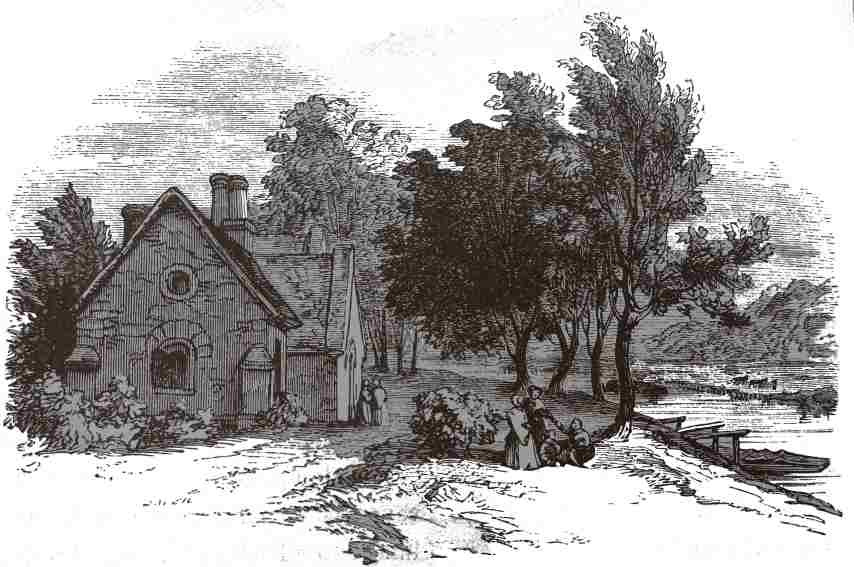
... the right bank edged by what plain prose must belittle as a wooded rise,
on whose top, pleasant rather than proud, stands a stately mansion
that has become a banyan-grove of houses, at this moment in suspense as to their future destiny.
Cooper's Hill was in Victorian times the property of one of those meteoric financiers flashing
across the sky of British commerce, the same who in London built for himself a house so large
that no one ever lived in it.
Then the place made itself a new name as a college for the Indian engineering service;
but this institution is now to be uprooted, and its halls, like those of Ossian's Balclutha,
will soon stand desolate.
What may become of them is a question still in the womb of time.
An academy for horse marines, a weekend club for members of Parliament,
a training school for county councillors, are suggestions that have been made;
but, to my mind, a truly Liberal Government might endow Cooper's Hill
as an asylum for minor poets.

Cooper's Hill, Brunel University
Map: Magna Carta Island
Left bank
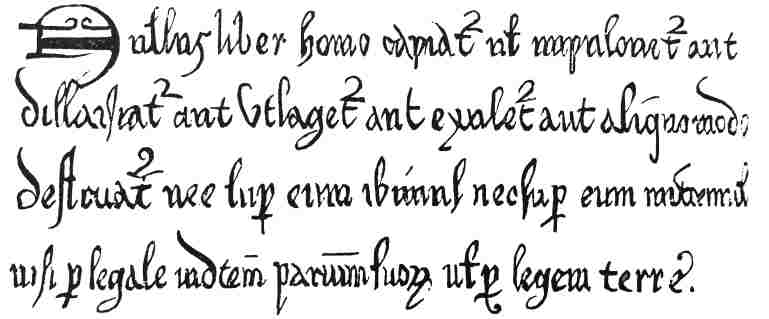
1215: June 15th, the signing of Magna Carta
1610: Camden -
that most famous Medow Runingmead, commonly called Runimed, in which the Baronage of England assembled in great number in the yeere 1215 to exact their liberties of King John. Whereof it The Marriage of Tame and Isis the Poet wrote thus, speaking of the Tamis that runneth hard by:
Hence runnes it hard by Medow greene, in English Renimed,
Where close in counsell sat the Lords, as well for armour dred
As ancient yeeres right reverend, who sought their soveraigne King
John to depose from regall throne, whiles that they ment to bring
(Contemning Prince) S. Edwards lawes and liberties againe
In use, which had long time forlet and quite forgotten laine.
Hence more than civill warres alowd the trumpets ganne to sound,
Hence Lewis of Fraunce, who soone retir' d, set foot on English ground.
Magna Carta from ‘The Genius of the Thames’ by Thomas Love Peacock –
And sweetly, on the mead below,
The fragrant gales of summer blow:
While flowers shall spring, while Thames shall flow,
That mead shall live in memory,
Where valor, on the tented field,
Triumphant raised his patriot shield,
The voice of truth to kings revealed,
And broke the chains of tyranny.
1792: Picturesque Views on the Thames by Samuel Ireland -
... the high road on the border of the river affords a
delightful ride through Runney Mead, a spot
where, however powerfully the imagination
may be struck with the richness and beauty
of the scenery, yet higher and much more
important considerations must here impress
themselves upon every generous and feeling
mind.
If a Tory by principle, and a pensioner from necessity, could say -
" Whatever withdraws us from the power of our senses ; whatever makes the past, the distant, or the future, predominate over the present,
advances us in the dignity of thinking beings. Far from me, and from my friends, be such frigid philosophy, as may conduct us indifferent and unmoved
over any ground which has been dignified by wisdom, bravery, or virtue. That man is little to be envied,
whose patriotism would not gain force upon the plain of Marathon !"
Surely in others an ardour, not less than enthusiastic, and a veneration,
not less than religious, ought to follow the
memory of those constitutional patriots, the
Barons, who, at the risque of their lives and
fortunes, here wrested an assumed power out
of the hands of a tyrant, and contributed to
restore an equal and reasonable influence in
the state to those, from whom alone the
title to govern can originate — THE PEOPLE.
1810: John Evans -
Near Runnymede, on the river Thames, is Magna Charta Island,
said to be the temporary and fortified residence of the Barons,
to which they retired from the pressure of the surrounding multitude assembled on Runnymede,
that they might have a better opportunity of obtaining the signature of King John
confirming the rights held under that palladium of our Liberty;
it is now nearly covered with willows that shade the hut of the fisherman.
Akenside, the Poet of Liberty, has imagined a Column on Runnymede, with these lines:—
Thou who the verdant plain dost traverse here,
While Thames, among his willows, from thy view
Retires—O stranger! stay thee, and the scene
Around contemplate well. This is the place
Where England's ancient Barons, clad in arms
And stern with conquest, from their tyrant king
(Then render'd tame) did challenge and secure
The Charter of thy Freedom ! Pass not on
'Till thou hast blest their memory, and paid
Those thanks which God appointed, the reward
Of public virtue! And if chance thy home
Salute thee with a father's honour'd name,
Go — call thy sons — instruct them what a debt
They owe their Ancestors, and make them swear
To pay it — by transmitting down entire
Those sacred Rights to which themselves were BORN !
1859: Mr & Mrs Hall –

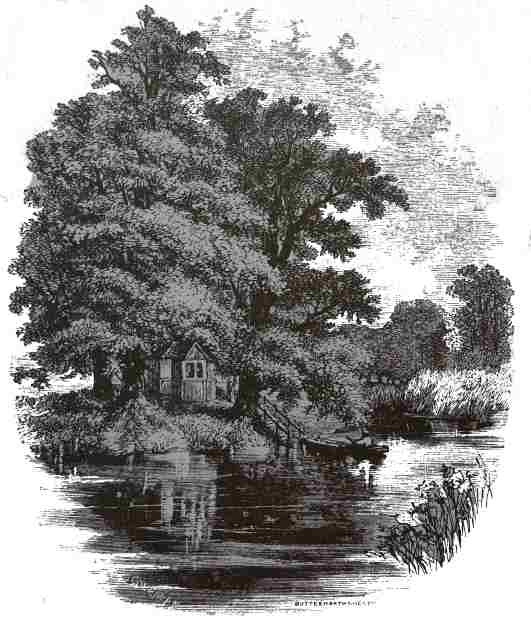
Cottage on Magna Charta Island, 1859
In the island which forms so charming a feature in the landscape, the Harcourts have built a small Gothic cottage – an altar house, so to call it. It contains a large rough stone, which tradition, or fancy, describes as that on which the parchment rested when the King and the barons affixed their signatures to “the Charter”. It has the following inscription:
Be it remembered that on this island,
in June, 1215,
King John of England signed the Magna Charta;
And in the year 1834,
this building was erected in commemoration of that great event
by George Simon Harcourt Esq.,
Lord of the Manor, and then High Sheriff of the County.
1870: Magna Carta Cottage, Henry Taunt

Magna Carta Cottage, Henry Taunt, 1870
© Oxfordshire County Council Photographic Archive; HT01282
1885: Dickens's Dictionary of the Thames -
Magna Carta Island ... one of the most charming islands on the river, and of historical interest
as the scene of that little arrangement between King John and his barons,
which, as "every schoolboy knows", was the foundation of the freedom of England. ...
The usual uncertainty and vagueness which characterise all history step in even at what
ought to be so very simple a matter as this. Tradition undoubtedly assigns the honour of
being the scene of signature to the island. But in the charter itself it is said to be given
at Runningmede, so that it would seem to be doubtful whether the finishing stroke was given
to the palladium of English liberties on this island itself. ...
1889: Jerome K Jerome -
We had originally intended to go on to Magna
Charta Island, a sweetly pretty part of the river, where it winds through a
soft, green valley, and to camp in one of the many picturesque inlets to be
found round that tiny shore. But,
somehow, we did not feel that we yearned for the picturesque nearly so much now
as we had earlier in the day. A bit of
water between a coal-barge and a gas-works would have quite satisfied us for
that night. We did not want
scenery. We wanted to have our supper
and go to bed. However, we did pull up
to the point - "Picnic Point," it is called - and dropped into a very
pleasant nook under a great elm-tree, to the spreading roots of which we fastened
the boat.
We went over to Magna Charta Island, and had a
look at the stone which stands in the cottage there and on which the great
Charter is said to have been signed; though, as to whether it really was signed
there, or, as some say, on the other bank at "Runningmede," I decline
to commit myself. As far as my own
personal opinion goes, however, I am inclined to give weight to the popular
island theory. Certainly, had I been one
of the Barons, at the time, I should have strongly urged upon my comrades the
advisability of our getting such a slippery customer as King John on to the
island, where there was less chance of surprises and tricks.
1906: Magna Charta Island, Mortimer Menpes -

Magna Charta Island, Mortimer Menpes, 1906
Map: French Brothers Ltd
RIGHT Bank opposite top of Magna Carta Island.
Passenger trips, party hire and catering afloat, 01753 851 900
Thames Steam Packet Boat Company, Steamer
Nuneham, [ 1898 ] available for private hire with skipper and
crew, bar and catering afloat, 01753 840 909
French Brothers Boats
Map: The Magna Carta Memorial
Right bank
Map: Runnymede, the J F Kennedy Memorial

Runnymede, 1999

Magna Carta , a full translation. Skip over all 63 paragraphs!
John, by the grace of God, king of England, lord of Ireland, duke of Normandy and Aquitaine, and count of Anjou, to the archbishops, bishops, abbots, earls, barons, justiciars, foresters, sheriffs, stewards, servants, and to all his bailiffs and liege subjects, greeting. Know that, having regard to God and for the salvation of our soul, and those of all our ancestors and heirs, and unto the honour of God and the advancement of holy church, and for the reform of our realm, by advice of our venerable fathers, Stephen archbishop of Canterbury, primate of all England and cardinal of the holy Roman Church, Henry archbishop of Dublin, William of London, Peter of Winchester, Jocelyn of Bath and Glastonbury, Hugh of Lincoln, Walter of Worcester, William of Coventry, Benedict of Rochester, bishops; of master Pandulf, subdeacon and member of the household of our lord the Pope, of brother Aymeric (master of the Knights of the Temple in England), and of the illustrious men William Marshall earl of Pembroke, William earl of Salisbury, William earl of Warenne, William earl of Arundel, Alan of Galloway (constable of Scotland), Waren Fitz Gerald, Peter Fits Herbert, Hubert de Burgh (seneschal of Poitou), Hugh de Neville, Matthew Fitz Herbert, Thomas Basset, Alan Basset, Philip d'Aubigny, Robert of Roppesley, John Marshall, John Fitz Hugh, and others, our liegemen.
1. In the first place we have granted to God, and by this our present charter confirmed for us and our heirs for ever that the English church shall be free, and shall have her rights entire, and her liberties inviolate; and we will that it be thus observed; which is apparent from this that the freedom of elections, which is reckoned most important and very essential to the English church, we, of our pure and unconstrained will, did grant, and did by our charter confirm and did obtain the ratification of the same from our lord, Pope Innocent III., before the quarrel arose between us and our barons: and this we will observe, and our will is that it be observed in good faith by our heirs for ever. We have also granted to all freemen of our kingdom, for us and our heirs for ever, all the underwritten liberties, to be had and held by them and their heirs, of us and our heirs for ever.
2. If any of our earls or barons, or others holding of us in chief by military service shall have died, and at the time of his death his heir shall be of full age and owe "relief" he shall have his inheritance on payment of the ancient relief, namely the heir or heirs of an earl, 100 pounds for a whole earl's barony; the heir or heirs of a baron, 100 pounds for a whole barony; the heir or heirs of a knight, 100 shillings at most for a whole knight's fee; and whoever owes less let him give less, according to the ancient custom of fiefs.
3. If, however, the heir of any of the aforesaid has been under age and inwardship, let him have his inheritance without relief and without fine when he comes of age.
4. The guardian of the land of an heir who is thus under age, shall take from the land of the heir nothing but reasonably produce, reasonable customs, and reasonable services, and that without destruction or waste of men or goods; and if we have committed the wardship of the lands of any such minor to the sheriff, or to any other who is responsible to us for its issues, and he has made destruction or waste of what he holds in wardship, we will take of him amends, and the land shall be committed to two lawful and discreet men of that fee, who shall be responsible for the issues to us or to him to whom we shall assign them; and if we have given or sold the wardship of any such land to anyone and he has therein made destruction or waste, he shall lose that wardship, and it shall be transferred to two lawful and discreet men of that fief, who shall be responsible to us in like manner as aforesaid.
5. The guardian, moreover, so long as he has the wardship of the land, shall keep up the houses, parks, fish ponds, stanks, mills, and other things pertaining to the land, out of the issues of the same land; and he shall restore to the heir, when he has come to full age, all his land, stocked with ploughs and "waynage, " according as the season of husbandry shall require, and the issues of the land can reasonably bear.
6. Heirs shall be married without disparagement, yet so that before the marriage takes place the nearest in blood to that heir shall have notice.
7. A widow, after the death of her husband, shall forthwith and without difficulty have her marriage portion and inheritance; nor shall she give anything for her dower, or for her marriage portion, or for the inheritance which her husband and she held on the day of the death of that husband; and she may remain in the house of her husband for fourty days after his death, within which time her dower shall be assigned to her.
8. No widow shall be compelled to marry, so long as she prefers to live without a husband; provided always that she gives security not to marry without our consent, if she holds of us, or without the consent of the lord of whom she holds, if she holds of another.
9. Neither we nor our bailiffs shall seize any land or rent for any debt, so long as the chattels of the debtor are sufficient to repay the debt; nor shall the sureties of the debtor be distrained so long as the principal debtor is able to satisfy the debt; and if the principal debtor shall fail to pay the debt, having nothing wherewith to pay it, then the sureties shall answer for the debt; and let them have the lands and rents of the debtor, if they desire them, until they are indemnified for the debt which they have paid for him, unless the principal debtor can show proof that he is discharged thereof as against the said sureties.
10. If one who has borrowed from the Jews any sum, great or small, die before that loan can be repaid, the debt shall not bear interest while the heir sunder age, of whomsoever he may hold; and if the debt fall into our hands, we will not take anything except the principal sum contained in the bond.
11. And if any one die indebted to the Jews, his wife shall have her dower and pay nothing of that debt; and if any children of the deceased are left underage, necessaries shall be provided for them in keeping with the holding of the deceased; and out of the residue the debt shall be paid, reserving, however, service due to feudal lords; in like manner let it be done touching debts due to others than Jews.
12. No scutage nor aid shall be imposed on our kingdom, unless by common counsel of our kingdom, except for ransoming our person, for making our eldest son a knight, and for once marrying our eldest daughter; and for these there shall not be levied more than a reasonable aid. In like manner it shall be done concerning aids from the city of London.
13. And the city of London shall have all its ancient liberties and free customs, as well by land as by water; furthermore, we decree and grant that all other cities, boroughs, towns, and ports shall have all their liberties and free customs.
14. And for obtaining the common counsel of the kingdom anent the assessing of an aid (except in the three cases aforesaid) or of a scutage, we will cause to be summoned the archbishops, bishops, abbots, earls, and greater barons, severally by our letters; and we will moreover cause to be summoned generally, through our sheriffs and bailiffs, all others who hold of us in chief, for a fixed date, namely, after the expiry of at least forty days, and at a fixed place; and in all letters of such summons we will specify the reason of the summons. And when the summons has thus been made, the business shall proceed on the day appointed, according to the counsel of such as are present, although not all who were summoned have come.
15. We will not for the future grant to any one license to take an aid from his own free tenants, except to ransom his body, to make his eldest son a knight, and once to marry his eldest daughter; and on each of these occasions there shall be levied only a reasonable aid.
16. No one shall be distrained for performance of greater service for a knight's fee, or for any other free tenement, than is due therefrom.
17. Common pleas shall not follow our court, but shall be held in some fixed place.
18. Inquests of novel disseisin, of mort d'ancester, and of darrein presentment, shall not be held elsewhere than in their own county courts and that in manner following, --We, or, if we should be out of the realm, our chief justiciar, will send two justiciars through every county four times a year, who shall, along with four knights of the county chosen by the county, hold the said assize in the county court, on the day and in the place of meeting of that court.
19. And if any of the said assizes cannot be taken on the day of the county court, let there remain of the knights and freeholders, who were present at the county court on that day, as many as may be required for the efficient making of judgments, according as the business be more or less.
20. A freeman shall not be amerced for a slight offense, except in accordance with the degree of the offense; and for a grave offense he shall be amerced in accordance with the gravity of the offense, yet saving always his "contenement;" and a merchant in the same way, saving his "merchandise;" and a villein shall be amerced in the same way, saving his "wainage"--if they have fallen into our mercy: and none of the aforesaid amercements shall be impsed except by the oath of honest men of the neighborhood.
21. Earls and barons shall not be amerced except through their peers, and only in accordance with the degree of the offense.
22. A clerk shall not be amerced in respect of his lay holding except after the manner of the others aforesaid; further, he shall not be amerced in accordance with the extent of his ecclesiastical benefice.
23. No village or individual shall be compelled to make bridges at river-banks, except those who from of old were legally bound to do so.
24. No sheriff, constable, coroners, or others of our bailiffs, shall hold pleas of our Crown.
25. All counties, hundreds, wapentakes, and trithings (except our demesne manors) shall remain at old rents, and without any additional payment.
26. If any one holding of us a lay fief shall die, and our sheriff or bailiff shall exhibit our letters patent of summons for a debt which the deceased owe to us, it shall be lawful for our sheriff or bailiff to attach and catalogue chattels of the deceased, found upon the lay fief, to the value of that debt, at the sight of law-worthy men, provided always that nothing whatever be thence removed until the debt which is evident shall be fully paid to us; and the residue shall be left to the executors to fulfil the will of the deceased; and if there be nothing due from him to us, all the chattels shall go to the deceased, saving to his wife and children their reasonable shares.
27. If any freeman shall die intestate, his chattels shall be distributed by the hands of his nearest kinsfolk and friends, under supervision of the church, saving to every one the debts which the deceased owed to him.
28. No constable or other bailiff of ours shall take corn or other provisions from any one without immediately tendering money therefor, unless he can have postponement thereof by permission of the seller.
29. No constable shall compel any knight to give money in lieu of castle-guard, when he is willing to perform it in his own person, or (if he cannot do it from any reasonable cause) then by another responsible man. Further, if we have led or sent him upon military service, he shall be relieved from guard in proportion to the time during which he has been on service because of us.
30. No sheriff or bailiff of ours, or other person, shall take the horses or carts of any freeman for transport duty, against the will of the said freeman.
31. Neither we nor our bailiffs shall take, for our castles or for any other work of ours, wood which is not ours, against the will of the owner of that wood.
32. We will not retain beyond one year and one day, the lands of those who have been convicted of felony, and the lands shall thereafter be handed over to the lords of the fiefs.
33. All kiddles for the future shall be removed altogether from Thames and Medway, and throughout all England, except upon the seashore.
34. The writ which is called praecipe shall not for the future be issued to any one, regarding any tenement whereby a freeman may lose his court.
35. Let there be one measure of wine throughout our whole realm; and one measure of ale; and one measure of corn, to wit, "the London quarter;" and one width of cloth (whether dyed, or russet, or "halberget"), to wit, two ellswithin the selvages; of weights also let it be as of measures.
36. Nothing in future shall be given or taken for a writ of inquisition of life or limbs, but freely it shall be granted, and never denied.
37. If any one holds of us by fee-farm, by socage, or by burgage, and holds also land of another lord by knight's service, we will not (by reason of that fee-farm, socage, or burgage) have the wardship of the heir, or of such land of his as is of the fief of that other; nor shall we have wardship of that fee-farm, socage, or burgage, unless such fee-farm owes knight's service. We will not by reason of any small serjeanty which any one may hold of us by the service of rendering to us knives, arrows, or the like, have wardship of his heir of of the land which he holds of another lord by knight's service.
38. No bailiff for the future shall, upon his own unsupported complaint, put any one to his "law, " without credible witnesses brought for this purpose.
39. No freeman shall be taken or imprisoned or disseised or exiled or in anyway destroyed, nor will we go upon him nor send upon him, except by the lawful judgment of his peers or by the law of the land.
40. To no one will we sell, to no one will we refuse or delay, right or justice.
41. All merchants shall have safe and secure exit from England, and entry to England, with the right to tarry there and to move about as well by land as by water, for buying and selling by the ancient and right customs, quit from all evil tolls, except (in time of war) such merchants as are of the land at war with us. And if such are found in our land at the beginning of the war, they shall be detained, without injury to their bodies or goods, until information be received by us, or by our chief justiciar, how the merchants of our land found in the land at war with us are treated; and if our men are safe there, the others shall be safe in our land.
42. It shall be lawful in future for any one (excepting always those imprisoned or outlawed in accordance with the law of the kingdom, and natives of any country at war with us, and merchants, who shall be treated as is above provided) to leave our kingdom and to return, safe and secure by land and water, except for a short period in time of war, on grounds of public policy--reserving always the allegiance due to us.
43. If any one holding of some escheat (such as the honor of Wallingford, Nottingham, Boulogne, Lancaster, or of other escheats which are in our hands and are baronies) shall die, his heir shall give no other relief, and perform no other service to us than he would have done to the baron, if that barony had been in the baron's hand; and we shall hold it in the same manner in which the baron held it.
44. Men who dwell without the forest need not henceforth come before our justiciars of the forest upon a general summons, except those who are impleaded, or who have become sureties for any person or persons attached for forest offenses.
45. We will appoint as justices, constables, sheriffs, or bailiffs only such as know the law of the realm and mean to observe it well.
46. All barons who have founded abbeys, concerning which they hold charters from the kings of England, or of which they have long-continued possession, shall have the wardship of them, when vacant, as they ought to have.
47. All forests that have been made such in our time shall forthwith be disafforested; and a similar course shall be followed with regard to river-banks that have been placed "in defense" by us in our time.
48. All evil customs connected with forests and warrens, foresters and warreners, sheriffs and their officers, river-banks and their wardens, shall immediately be inquired into in each county by twelve sworn knights of the same county chosen by the honest men of the same county, and shall, within forty days of the said inquest, be utterly abolished, so as never to be restored, provided always that we previously have intimation thereof, or our justiciar, if we should not be in England.
49. We will immediately restore all hostages and charters delivered to us by Englishmen, as sureties of the peace or of faithful service.
50. We will entirely remove from their bailiwicks, the relations of Gerard Athee (so that in future they shall have no bailiwick in England); namely, Engelard of Cigogne, Peter, Guy, and Andrew of Chanceaux, Guy of Cigogne, Geoffrey of Martigny with his brothers, Philip Mark with his brothers and his nephew Geoffrey, and the whole brood of the same.
51. As soon as peace is restored, we will banish from the kingdom all foreign-born knights, cross-bowmen, sergeants, and mercenary soldiers, who have come with horses and arms to the kingdom's hurt.
52. If any one has been dispossessed or removed by us, without the legal judgment of his peers, from his lands, castles, franchises, or from his right, we will immediately restore them to him; and if a dispute arise over this, then let it be decided by the five-and-twenty barons of whom mention is made below in the clause for securing the peace. Moreover, for all those possessions, from which any one has, without the lawful judgment of his peers, been disseised or removed, by our father, King Henry, or by our brother, King Richard, and which we retain in our hand (or which are possessed by others, to whom we are bound to warrant them) we shall have respite until the usual term of crusaders; excepting those things about which a plea has been raised, or an inquest made by our order, before our taking of the cross; but as soon as we return from our expedition (or if perchance we desist from the expedition) we will immediately grant full justice therein.
53. We shall have, moreover, the same respite and in the same manner in rendering justice concerning the disafforestation or retention of those forests which Henry our father and Richard our brother afforested, and concerning wardship of lands which are of the fief of another (namely, such wardships as we have hitherto had by reason of a fief which any one held of us by knight's service), and concerning abbeys founded on other fiefs than our own, in which the lord of the fief claims to have right; and when we have returned, or if we desist from our expedition, we will immediately grant full justice to all who complain of such things.
54. No one shall be arrested or imprisoned upon the appeal of a woman, for the death of any other than her husband.
55. All fines made with us unjustly and against the law of the land, and all amercements imposed unjustly and against the law of the land, shall be entirely remitted, or else it shall be done concerning them according to the decision of the five-and-twenty barons of whom mention is made below in the clause for securing the peace, or according to the judgment of the majority of the same, along with the aforesaid Stephen, archbishop of Canterbury, if he can be present, and such others as he may wish to bring with him for this purpose, and if he cannot be present the business shall nevertheless proceed without him, provided always that if any one or more of the aforesaid five-and-twenty barons are in a similar suit, they shall be removed as far as concerns this particular judgment, others being substituted in their places after having been selected by the rest of the same five-and-twenty for this purpose only, and after having been sworn.
56. If we have disseised or removed Welshmen from lands or liberties, or other things, without the legal judgment of their peers in England or in Wales, they shall be immediately restored to them; and if a dispute arise over this, then let it be decided in the marches by the judgment of their peers; for tenements in England according to the law of England, for tenements in Wales according to the law of Wales, and for tenements in the marches according to the law of the marches. Welshmen shall do the same to us and ours.
57. Further, for all those possessions from which any Welshman has, without the lawful judgment of his peers, been disseised or removed by King Henry our father or King Richard our brother, and which we retain in our hand (or which are possessed by others, to whom we are bound to warrant them) we shall have respite until the usual term of crusaders; excepting those things about which a plea has been raised or an inquest made by our order before we took the cross; but as soon as we return (or if perchance we desist from our expedition), we will immediately grant full justice in accordance with the laws of the Welsh and in relation to the foresaid regions.
58. We will immediately give up the son of Llywelyn and all the hostages of Wales, and the charters delivered to us as security for the peace.
59. We will do toward Alexander, King of Scots, concerning the return of his sisters and his hostages, and concerning his franchises, and his right, in the same manner as we shall do toward our other barons of England, unless it ought to be otherwise according to the charters which we hold from William his father, formerly King of Scots; and this shall be according to the judgment of his peers in our court.
60. Moreover, all these aforesaid customs and liberties, the observance of which we have granted in our kingdom as far as pertains to us toward our men, shall be observed by all of our kingdom, as well clergy as laymen, as far as pertains to them toward their men.
61. Since, moreover, for God and the amendment of our kingdom and for the better allaying of the quarrel that has arisen between us and our barons, We have granted all these concessions, desirous that they should enjoy them incomplete and firm endurance for ever, we give and grant to them the underwritten security, namely, that the barons choose five-and-twenty barons of the kingdom, whomsoever they will, who shall be bound with all their might, to observe and hold, and cause to be observed, the peace and liberties we have granted and confirmed to them by this our present Charter, so that if we, or our justiciar, or our bailiffs or any one of our officers, shall in anything beat fault toward any one, or shall have broken any one of the articles of the peace or of this security, and the offense be notified to four barons of the foresaid five-and-twenty, the said four barons shall repair to us (or our justiciar, if we are out of the realm) and, laying the transgression before us, petition to have that transgression redressed without delay. And if we shall not have corrected the transgression (or, in the event of our being out of the realm, if our justiciar shall not have corrected it) within forty days, reckoning from the time it has been intimated to us (or to our justiciar, if we should be out of the realm), the four barons aforesaid shall refer that matter to the rest of the five-and-twenty barons, and those five-and-twenty barons shall, together with the community of the whole land, distrain and distress us in all possible ways, namely, by seizing our castles, lands, possessions, and in any other way they can, until redress has been obtained as they deem fit, saving harmless our own person, and the persons of our queen and children; and when redress has been obtained, they shall resume their old relations toward us. And let whoever in the country desires it, swear to obey the orders of the said five-and-twenty barons for the execution of all the aforesaid matters, and along with them, to molest us to the utmost of his power; and we publicly and freely grant leave to every one who wishes to swear, and we shall never forbid any one to swear. All those, moreover, in the land who of themselves and of their own accord are unwilling to swear to the twenty-five to help them in constraining and molesting us, we shall by our command compel the same to swear to the effect aforesaid. And if any one of the five-and-twenty barons shall have died or departed from the land, or be incapacitated in any other manner which would prevent the foresaid provisions being carried out, those of the said twenty-five barons who are left shall choose another in his place according to their own judgment, and he shall be sworn in the same way as the others. Further, in all matters, the execution of which is intrusted to these twenty-five barons, if perchance these twenty-five are present, that which the majority of those present ordain or command shall be held as fixed and established, exactly as if the whole twenty-five had concurred in this; and the said twenty-five shall swear that they will faithfully observe all that is aforesaid, and cause it to be observed with all their might. And we shall procure nothing from any one, directly or indirectly, whereby any part of these concessions and liberties might be revoked or diminished; and if any such thing has been procured, let it be void and null, and we shall never use it personally or by another.
62. And all the ill-will, hatreds, and bitterness that have arisen between us and our men, clergy and lay, from the date of the quarrel, we have completely remitted and pardoned every one. Moreover, all trespasses occasioned by the said quarrel, from Easter in the sixteenth year of our reign till the restoration of peace, we have fully remitted to all, both clergy and laymen, and completely forgiven, as far as pertains to us. And, on this head, we have caused to be made for them letters testimonial patent of the lord Stephen, archbishop of Canterbury, of the lord Henry, archbishop of Dublin, of the bishops aforesaid, and of Master Pandulf as touching this security and the concessions aforesaid.
63. Wherefore it is our will, and we firmly enjoin, that the English Church be free, and that the men in our kingdom have and hold all the aforesaid liberties, rights, and concessions, well and peaceably, freely and quietly, fully and wholly, for themselves and their heirs, of us and our heirs, in all respects and in all places for ever, as is aforesaid. An oath, moreover, has been taken, as well on our part as on the part of the barons, that all these conditions aforesaid shall be kept in good faith and without evil intent. Given under our hand--the above-named and many others being witnesses--in the meadow which is called Runnymede, between Windsor and Staines, on the fifteenth day of June, in the seventeenth year of our reign.
(1215)

The following are the Magna Carta river related items (summarised) -
13. The city of London shall have all its ancient liberties and free customs, as well by land as by water
Interesting implication that the rights by water were more firmly established than by land?
23. No village or individual shall be compelled to make bridges at river-banks, [unless] legally bound to do so.
No one has to build bridges unless they have to! It was generally said to be a religious obligation - but one can suspect that those who felt religiously obliged were not usually those who had to do the work!
33. All kiddles [weirs] for the future shall be removed altogether from Thames and Medway
This was an issue of Navigation versus milling and fishing. Weirs before locks were in general seen as obstructions to navigation. The national interest was for free navigation. Unfortunately the local interest was in general for milling and fishing - so it never happened and these tensions continued into the twentieth century.
47. River-banks that have been placed "in defense" by us in our time [shall be opened up again].
Presumably this refers to military occupation of the river disrupting navigation, milling and fishing?
48. All evil customs connected with river-banks and their wardens, shall immediately be inquired into [locally, soon] and utterly abolished.
Evil customs to do with river wardens? This might be a more exciting job than first appears!
Volunteer details!.
There is some debate as to whether Magna
Carta was quite the foundation of democracy and human rights that some people
have claimed - but Rudyard Kipling (1865-1936) had no doubts -
At Runnymede, at Runnymede,
What say the reeds at Runnymede?
The lissom reeds that give and take,
That bend so far, but never break,
They keep the sleepy Thames awake
With tales of John at Runnymede.
At Runnymede, at Runnymede,
Oh, hear the reeds at Runnymede:
'You musn't sell, delay, deny,
A freeman's right or liberty'.
It wakes the stubborn Englishry,
We saw 'em roused at Runnymede!
When through our ranks the Barons came,
With little thought of praise or blame,
But resolute to play the game,
They lumbered up to Runnymede;
And there they launched in solid line
The first attack on Right Divine,
The curt uncompromising 'Sign!'
They settled John at Runnymede.
At Runnymede, at Runnymede,
Your rights were won at Runnymede!
No freeman shall be fined or bound,
Or dispossessed of freehold ground,
Except by lawful judgment found
And passed upon him by his peers.
Forget not, after all these years,
The Charter signed at Runnymede.
And still when mob or Monarch lays
Too rude a hand on English ways,
The whisper wakes, the shudder plays,
Across the reeds at Runnymede.
And Thames, that knows the moods of kings,
And crowds and priests and suchlike things,
Rolls deep and dreadful as he brings
Their warning down from Runnymede!
Hugh Chesterman (Charta Rap!) -
John was a tyrant, John was a tartar
But John put his name to the great big charter.
Every baron from the Thames to the Tweed
Followed the road down to Runnymede;
All the barons had something to say
To poor, confused King John that day,
"Please sign your name", said Guy de Gaunt,
"It's easily done, it's all we want."
"A 'J' and an 'O' and an 'H' and an 'N',"
Said Hugo, Baron of Harpenden;
Quietly spoke the Lord of St. Pere,
"Your name, my king, to be writ just here."
And with so many hurrying him on
One can't help feeling sorry for John.
THE NATIONAL TRUST
THIS OAK TREE, PLANTED WITH SOIL FROM JAMESTOWN, VIRGINIA, THE FIRST PERMANENT ENGLISH
SETTLEMENT IN THE NEW WORLD, COMMEMORATES THE BICENTENARY OF THE CONSTITUTION OF THE UNITED
STATES OF AMERICA.
IT STANDS IN ACKNOWLEDGEMENT THAT THE IDEALS OF LIBERTY AND JUSTICE
EMBODIED IN THE CONSTITUTION TRACE THEIR LINEAGE THROUGH INSTITUTIONS OF ENGLISH LAW TO
THE MAGNA CARTA SEALED AT RUNNYMEDE ON JUNE 15TH, 1215.
PLANTED DECEMBER 2, 1987,
BY JOHN O.MARSH, JR., SECRETARY OF THE ARMY OF THE UNITED STATES OF AMERICA.
[ The true inheritance from Magna Carta is this:
That every person is entitled to be treated with respect and justice.
But this world has its fair share of barbarians who deny this. How do we humans counter that threat?
We all have to choose which side we are on.
We do that - not by being good Christians or Muslims or Jews;
nor by being American or British or Iraqi; but we choose by our actions.
The BARBARIANS USE VIOLENCE - they kill and bomb and shoot and torture.
(Some of them do it legally in their opinion. It makes no difference to the killed and bombed and shot and tortured.)
(Some of them do it to follow their religion. It makes no difference to the killed and bombed and shot and tortured.)
They do not respect the rights of those with whom they disagree. In short they are barbaric.
So draw up a list - who uses violence? Who bombs and shoots and tortures? They are the barbarians!
So choose by your actions are you a barbarian or not? Does your money pay for some violent organisation? Mine does
and I have no choice - but at least I can shout about it.
BARBARIANS CANNOT BE DEFEATED BY FORCE. All you can do by force is become one of them, join them in
their barbarity, ensure the triumph of violence.
So if we humans can't fight what do we do? Surrender? No, what we can do is
help us all to cease to be barbarians by WORKING FOR LOVE AND TRUST AND RESPECT AND LIBERTY AND JUSTICE AND FAIR TRADE.
That is a hard road which takes true courage -
and there is no other.
Rant over.
There you were just enjoying the Thames and some clot is preaching at you! Well in the end it's because
I want us all to go on enjoying the Thames and minding our own business in peace. ]
Mark Akenside (1721-1770) For a Column at Runnymede -
Thou, who the verdant plain dost traverse here
While Thames among his willows from thy view
Retires; O stranger, stay thee, and the scene
Around contemplate well. This is the place
Where England's ancient barons, clad in arms
And stern with conquest, from their tyrant king
(Then rendered tame) did challenge and secure
The charter of thy freedom. Pass not on
Till thou hast blest their memory, and paid
Those thanks which God appointed the reward
Of public virtue. And if chance thy home
Salute thee with a father's honour'd name,
Go, call thy sons: instruct them what a debt
They owe their ancestors; and make them swear
To pay it, by transmitting down entire
Those sacred rights to which themselves were born.
Map: Pat's Croft Eyot
Left bank
Upstream to the Bells of Ousely
Estuary
PLA
QEII Br
Barrier
Tower Br
Custom Ho
London Br
; Frost Fairs
Cannon St Rb
The Great Stink
Southwark Br
Millenium Br
Blackfriars Rb
Blackfriars Br
Waterloo Br
Charing Cross Rb
Westminster Br
Lambeth Br
Vauxhall Br
Victoria Rb
Chelsea Br
Albert Br
Battersea Br
Battersea Rb
Wandsworth Br
Fulham Rb
Putney Br
Hammersmith Br
Barnes Rb
Chiswick Br
Kew Rb
Kew Br
RICHMOND
Twickenham Br
Richmond Rb
Richmond Br
TEDDINGTON
Kingston Rb
Kingston Br
Ditton Slip
Hampton Br
MOLESEY
SUNBURY
Walton Br
Desborough Cut
SHEPPERTON
Chertsey Br
CHERTSEY
M3 Br
Laleham Slip
PENTON HOOK
Staines Rb
Staines Br
Runnymede Br
BELL WEIR
Magna Carta Is
OLD WINDSOR
Albert Br
Datchet
Victoria Br
Black Potts Rb
ROMNEY
Eton
Windsor Br
Windsor Rb
Windsor Slip
Elizabeth Br
BOVENEY
Dorney Lake
York Cut
Summerleaze Fb
MonkeyIsland
New Thames Br
BRAY
Bray Slip
Maidenhead Rb
Maidenhead Br
Below Boulters
BOULTERS
Cliveden
Hedsor
COOKHAM
Cookham Slip
Cookham Br
BourneEnd RFb
Quarry Woods
A404 Br
MARLOW
Marlow Br
Bisham
TEMPLE
HURLEY
Medmenham
Culham Ct
Aston Slip
HAMBLEDEN
Temple Is
Fawley Ct
Remenham
Regatta
Phyllis Ct
Henley Slip
Leander
Red Lion
Henley Br
Angel on Br
Landing
Hobbs Boatyard
Hobbs Slipway
MARSH
Hennerton
Bolney
Wargrave
Shiplake Rb
R.Loddon
SHIPLAKE
Sonning Br
SONNING
Dreadnought
K&A Canal
CAVERSHAM
Reading Br
Caversham Br
Reading Slip
Purley
MAPLEDURHAM
Hardwick Ho
Whitchurch Br
WHITCHURCH
Hartswood Reach
Gatehampton Rb
Goring Gap
Goring Br
GORING
Swan
CLEEVE
Moulsford
Moulsford Rb
Papist Way Slip
Winterbrook Br
Wallingford Br
BENSON
Shillingford Br
R.Thame
DAYS
Burcot
Clifton Hampden
Clifton Church
Clifton H Br
Barley Mow
Long Wittenham
CLIFTON
Appleford Rb
Sutton Courtenay
Sutton Br
CULHAM
Culham Cut Fb
Abingdon Slip
Abingdon
Abingdon Br
ABINGDON
Nuneham Rb
Nuneham
Nuneham Park
Radley Boats
SANDFORD
Rose Island
Kennington Rb
Isis Br
Iffley Mill
IFFLEY
Oxford Rowing
Isis
Donnington Br
Riverside Slip
Boathouses
Punting
Lower Cherwell
Upper Cherwell
Islip
Head of River
Salters Steamers
Folly Br
Bacons Folly
Oxford Fb
Osney Fb
Weir stream
Osney Rb
Bullstake Stream
Osney Marina
OSNEY
Osney Br
Four Rivers
OLD RIVER
CANAL
Medley Weir Site
Medley Fb
Bossoms
Perch
Trout
GODSTOW
Godstow Nunnery
Godstow Br
Thames Br
KINGS
River Evenlode
EYNSHAM
Swinford Br
Oxford Cruisers
PINKHILL
Farmoor
Stanton Harcourt
Bablock Slip
Arks Weir Site
NORTHMOOR
Harts Fb
//Rose Revived
Newbridge
//Maybush
River Windrush
below Shifford
SHIFFORD
Shifford Fb
Tenfoot Fb
Trout Inn
Tadpole Br
RUSHEY
Old Mans Fb
RADCOT
Radcot Cradle Fb
Swan Inn
Radcot New Br
Radcot Old Br
GRAFTON
Eaton Hastings
Kelmscott
Eaton Fb
BUSCOT
Bloomers Hole Fb
Trout Inn
St Johns Br
ST JOHNS
Halfpenny Br
Marina Slip
LIMIT
Inglesham
Hannington Br
Kempsford
Castle Eaton Br
Marston Meysey
A419 Br
Cricklade
SOURCE?
THAMES HEAD
SEVEN SPRINGS