Cookham Bridge, A4094, Ferry Lane, Cookham
Note that there may be two "Ferry Lanes" on the Cookham side - or perhaps the main road is not called Ferry Lane until it reaches the north bank? Alternatively realise that there were at least two ferries here (one replaced by the bridge, and the other from what is now the slip beside the Ferry Inn to the towpath on the north bank of the lock cut.)
Bellrope Meadow (left bank above Cookham Bridge) - Mooring notice:
| ROYAL BOROUGH WINDSOR & MAIDENHEAD BELLROPE MEADOW FREE MOORING BETWEEN 10.00 - 14.00 HRS MOORING FEE FROM £5.00 DUE FOR ANY OTHER PERIOD NO BOAT TO BE LEFT UNATTENDED OVERNIGHT WITHOUT PRIOR ARRANGEMENT WITH BAILIFF |
|---|
1910: Cookham in Thames Villages by Charles Harper.
Hilaire Belloc -
The antiquity of the crossing of the Thames at Cookham is supported by a certain amount of pre-historic evidence, worth about as much as such evidence ever is, and about as little. Two Neolithic flint knives have been found there, a bronze dagger sheath and spear-head, a bronze sword, and a whole collection or store of other bronze spear-heads. Such as it is, it is a considerable collection for one spot. Cookham has not only these pre-historic remains; it has also fragments of British pottery found in the relics of pile dwellings near the river, and two Roman vases from the bed of the stream; it has further furnished Anglo-Saxon remains, and, indeed, there are very few points upon the river where so regular a continuity of the historic and the pre-historic is to be discovered as in the neighbourhood of this old ford.
David Nash Ford:-
The Camlet Way ran from St. Albans to Silchester and appears to have crossed the Thames at Sashes Island in Cookham. Wooden piles and stakes found here in the nineteenth century (and again in 1969) may indicate the remains of a substantial bridge. There was probably an adjoining river port named Cwch-ium - Celtic for Boat-Place (the alternative Saxon Cook's Home seems somewhat obscure).
Sashes Island is what is now effectively Cookham lock island, and was called Odney Island
 1834 Cookham before the bridge
I can find no mention of a
bridge before 1839 except this entry in a policeman's diary:
1821: In the diary of W Gibbins, Constable 1795-1840 -
Dec 21. A very high Flood and Cookham Bridge was Drove a way and a Great Deal of Damage Don.
[ I now think this is an example of the use of the word 'bridge' to mean any river crossing - not necessarily involving a fixed structure. In other words what was 'drove away' was a ferry boat [landing stage]! See Lambeth Bridge for a similar use. ]
1839: Work started by Freebody on building a wooden bridge. The figures given were:
£1918: Estimate for a bridge in fir
£1968: Estimate for a bridge in Fir and Quebec Oak
£2931: Estimate for a bridge in English Oak
Actual cost:
£2565: Buying out the ferry
£1485: Legal costs and sundries
£2745: Final Total [presumably of building]
[£6795: presumed total]
1840: Jan 1. Constable Gibbins -
Cookham Bridge opened for Travack.
1859: The Thames, Mr & Mrs Hall
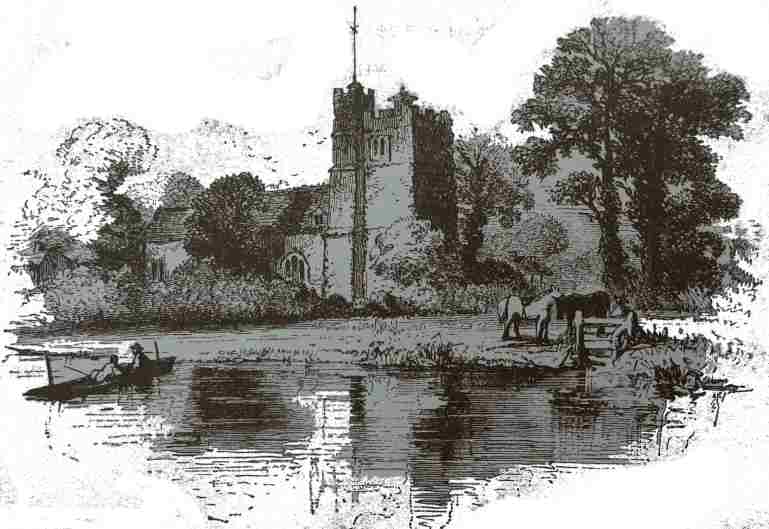
COOKHAM CHURCH
On the opposite bank — in Berkshire, that is to say — is Cookham, a pretty village, with a fine old church. A little lower down, and we row beside a lovely island of some acres in extent; it has been laid out in charming walks, with here and there seats for rest, and summer-houses, — every corner planted with fair flowers, shrubs, and cheerful evergreens. Another island — Formosa Island — somewhat further on, greets the voyager, and is also full of attractions.
1859: It seemed doubtful if the timber bridge would survive the winter.
1865: I am not sure when the first bridge met its end. Six years later it looked like this - I think it is only half a bridge - and the vehicle ferry is in use in place of it

The first Cookham Bridge (1840 - 1865?) seen in 1865.
1867: The current wrought-iron bridge, resting on
cylindrical iron piers, was built at a cost considerably less than the wooden
bridge it replaced.
1872: Modern Examples of Road
and Railway Bridges:
illustrating the most recent practice of leading engineers in Europe and America.
William H. Maw and James Dredge

The Bridge over the Thames, at Cookham, is remarkable, not for its size, nor for difficulties attending its erection, but for the cheapness with which it was constructed. When the Cookham Bridge Company decided on the construction of the new bridge, the directors advertised for designs, and in return thirty seven plans and estimates were sent in, these estimates varying from £1,900 to £27,000.
In Brunel's papers is this sketch for Cookham Bridge (but I don't know the date):

Brunel's rejected design for Cookham Bridge
It would have been a more elegant bridge, but no doubt more expensive.

Plaque on Cookham Bridge
The tender accepted was that
of Messrs. Pease, Hutchinson, and Co., of the Skerne Ironworks, Darlington, and
32, Coleman-street, London, whose estimate was
£2,520; and
premiums were awarded for the two next best designs, those of Messrs. Peto and
Co. and Mr John Pinchbeck, of London.
The bridge, of which we give
a perspective view is 335 ft. long over all, while its
length between abutments is 300 ft. The
clear width of the roadway is 20 ft., and the height of the bridge at the
centre from the bed of the river to the top of the handrail, is 30 ft.
The bridge has a rise towards the centre of 2
ft. 6 in. The superstructure consists of
a wrought iron continuous girder supported at intervals of 40 ft. upon piers
formed of iron piles. The main girders
are 3 ft. 6 in. deep, with webs 5/16 in. thick, and
top and bottom flanges 12 in. by 5/8 in.
The flanges of each girder are joined to the web by pairs of 3 in. by 3
in. by ½ in. angle irons. The girders
are firmly bolted to the three centre piers, and rest on the remainder on
expansion rollers. They also rest on
expansion rollers at the two abutments.
Ornamental cast-iron brackets are introduced at the angles formed by the
piers and girders, as represented in Fig. 2 -
The transverse girders, which are
placed 6 ft. 8 in. apart from centre to centre, are of wrought iron, 14 in.
deep, with ¼ in. webs, and top and bottom flanges, each formed of a pair of 3½
in. by 3½ in. angle irons.

The platform is of Memel planking, 3 in. thick,
carried by short longitudinal beams, 11 in. deep by 5½ in. thick, the ends of
which are inserted between the flanges of the transverse girders. The platform was covered with a thick coat of
asphalte before the metalling was put on.
The abutments are of red brick, with ashlar caps and string course.
Their face walls are 3 ft., and the wing
walls 2 ft., thick at the top, with a batter of 1 in 8.
The piers are each composed of two screw
piles, as shown in Figs. 1 and 2. In
order to guard against the action of ice, &c., the lower portion of each
pile, up to about 5 ft. above the water level, is made of wrought iron plate ½
in. thick. This lower portion of each
pile is 1 ft. 8 in. in diameter outside, and it is filled in with
concrete. The upper portion of each
pile, which is of cast iron, is 10½ in. in diameter and ¾ in. thick.
The transverse girders connecting the piles
are 12 in. deep, and the cross bracing of the lower portions of the piles
consists of 4 in. by ½ in. angle irons, and that of the upper portions of flat
bars 4 in. by ¾ in. The piles are
screwed down into the bed of the river to depths of from 6 ft. to 10 ft.
The contract price for the bridge was, as we have already stated, £2,520, a
remarkably low one for the work done, and only explicable from the fact of the
contractors being large iron manufacturers as well as extensive bridge
builders. There were no extras charged
and the amount above mentioned included the iron, brick, stone, and timber
work, the excavation, labour, erection, carriage, &c.;
in fact, the cost of the whole bridge,
complete as it now stands, in addition to the removal of the old structure,
which it replaced. The work was quickly
and successfully carried out under the superintendence of Mr. W. G. Fossick,
Mr. William Atkinson, C.E., of Westminster,
acting as the representative of the Cookham Bridge Company.
1875: Cookham Bridge, Henry Taunt -

Cookham Bridge, Henry Taunt, 1875
© Oxfordshire County Council Photographic Archive; HT02078
1883: QUERY! Henry Taunt, described as Cookham Bridge 1883 but I think there must be a mistake?
1885: Lippincott's Magazine, Cookham Dean by Margaret Bertha Wright -
One or two real Venetian gondolas are kept at that river-reach where we spent our summer.
The owner of the principal one is an English nobleman who lived long in Italy
and whose twelve daughters were born there.
It is a sight to see those twelve beautiful sisters, from six years of age to twenty-four,
poled down the river to church every Sunday morning by a swarthy and veritable Venetian gondolier.
Whether or not that hearse-like craft has sacred associations in the minds of the twelve maidens all in a row,
or whether its grimness and want of swiftness seem out of place amid the carnival brilliancy of Sunday afternoon,
it is certain that it is never used except for church-going,
and the maidens appear later in the day each in her own swift little canoe,
or two or three sisters together in a larger one, darting to and fro, hither and yon,
with almost incredible swiftness, almost more like winged thoughts than like even swallows on the wing.
The gabled and ivy-wreathed Elizabethan manor-house which is the summer home of the maidens
stands but a few rods from the river's bank.
Here, amidst decorous shrubbery, upon smooth shaven and rolled turf, where marble vases overflow with gorgeous flowers,
sit Pater and Mater among their dozens of guests.
Some of the gentlemen are in correct morning dress, some in boating-costumes,
and some in that last stage of unclothedness or first of clothedness which is the English bathing-dress.
In their striped tights on land these last look exactly like saw-dust and rope ring clowns,
but when they dive into the water from that well-bred lawn and dart in wild pursuit of the maidens,
who beat them off with oars from climbing into the canoes, amid shouts of aquatic and terrestrial laughter,
one would almost swear they were neither the clowns they looked a moment ago,
nor yet the English gentlemen they really are, but fantastic mermen bent upon carrying earth-brides
back with them into their cool native depths beneath the bright water.
1890: Cookham Bridge and Church, Francis Frith -

1992: Skyscan's Aerial View of Cookham Bridge in The Secret Thames -

Skyscan's Aerial View of Cookham Bridge.
1920: Fred Thacker, The Thames Highway:
"It has been described as the cheapest bridge on the river for its size. "
Fred had a devastating understated humour; he adds
"Its appearance is not unfavourable to the statement".
Ironically he goes on:
"But it is at least white"
1999: Oh no its not! It's a terrible sort of depressing blue.
What is Cookham trying to say about itself?
Whatever it is I don't want to know!
Cookham is a lovely place.

Cookham Bridge.
Don't look too closely! That
blue might be subliminal.

Cookham Bridge, Timmy Mallett © 2002
Timmy Mallett writes of his painting -
This is Cookham bridge over the Thames. There was a huge outcry when it was painted this bright blue.
I think it's a great colour!
I once hit the pillars of this bridge in a hire boat! Don't ever ask me to steer......
Up on the bridge is my artist mate and fellow Cookham Wanderer,
Stevie Smith, who painted the same view with me.
It was a grey old English day on the day we sat painting this but the reflections
were wonderful - especially of the lovely orange red brick hexagonal toll house.

1936: View from Cookham Bridge, Stanley Spencer

View from Cookham Bridge, Stanley Spencer, 1936