* NOTE: Hambleden Lock figures are not available online! The three locks diagram cannot be shown.
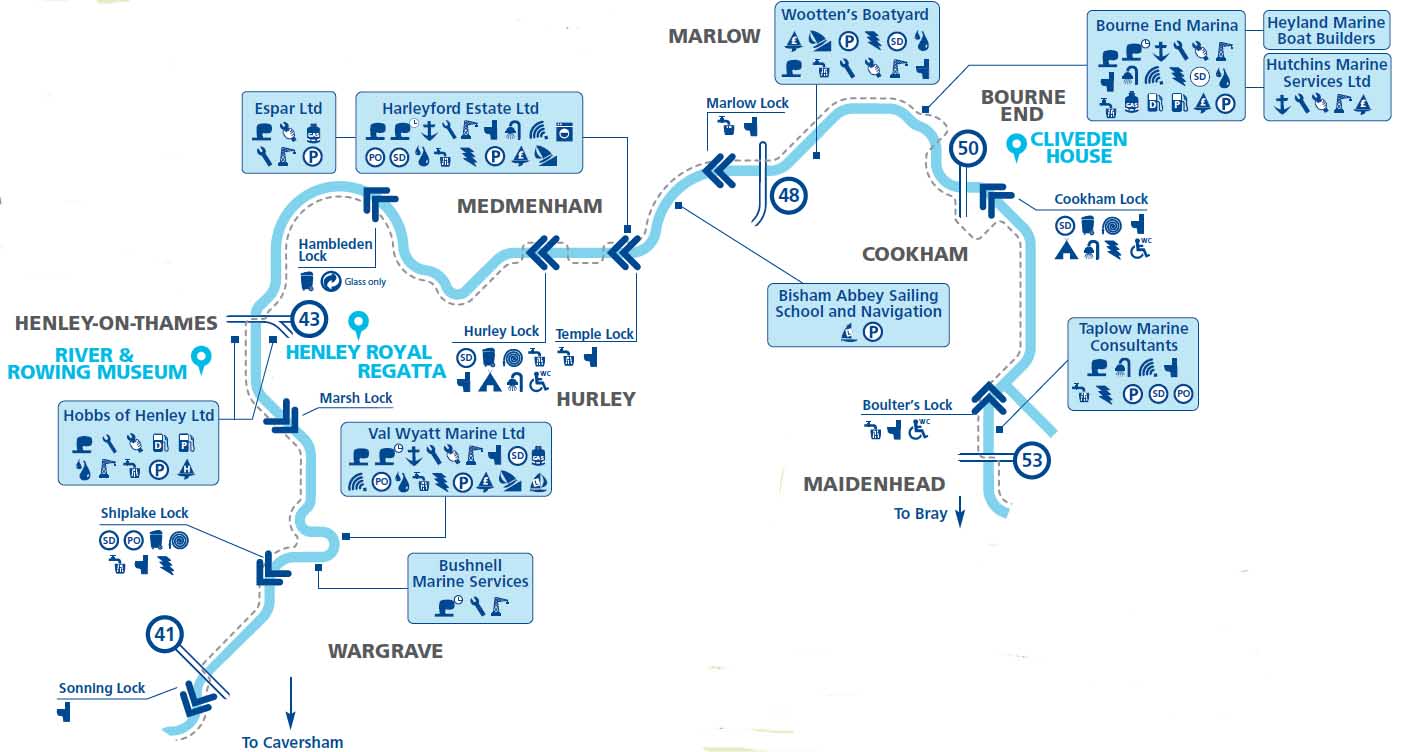
Left Bank Lock, tel: 01491 571269, length: 135'2", width: 17'9"
Hambleden Weir for canoists.
See also.
Hambleden Mill (and therefore weir) is in the Domesday Book
1376: Hamelden Weir held by
Richard le Scrope mentioned in a petition against the heightening and enlarging
of weirs.
1380s?: Inquest into the deaths
of John Wyllus and Robert Asshele. With
many others they were hauling a vessel up the weir with two cables, and were
killed through the lines parting and striking them so violently that their
heads were broken. A "landwynch" is
mentioned.
1580: Weir held by the Scrope family
1746: Griffiths mentions Hambleden
1773: Poundlock built
1774: A small wooden house provided for the keeper.
1777: Caleb Gould appointed as keeper.
1794: Report of a survey of the river Thames between Reading and Isleworth ... John Rennie (the Elder)
At Hambleton Lock I found five feet depth of water on the upper sill, and four feet seven inches on the lower sill,
the water being three inches above pen in the pond below.
There is a flash lock (the property of Sir Robert Clayton) and a gauge weir.
The water from the gauge weirs, used very much to annoy the tail channel of the lock in time of floods;
but a piece of camshot has been erected to defend it, and it has had a very good effect;
but being now somewhat out of repair, I think unless mended,
the navigation will experience great inconvenience from the floods.
There is a fall of one feet six inches from the tail of this lock to the head of Hurley Lock,
a considerable part of which is in the first half mile from the [below Hambleden] lock.
If the lower sill of [Hambleden] lock was to be sunk eighteen inches,
and the Channel ballasted [dredged] out for about twelve or fourteen inches deep,
taking it between the small ayt opposite the tail of the Mile-End mill, and the Berks shore,
I have no doubt a sufficient depth of water would always be preserved;
but the water which comes both from the Tumbling Bay and the mill tail,
should be prevented from coming into the channel, at right angles to its course;
between Hambleton Ferry and Magpye ayt there are two shoals about thirty yards long each,
which should be deepened about six inches.
1814: The lock dilapidated; the upper gates had to be opened with tackle
on account of the leaky state of the lower gates.
1825: New barge channel
excavated below lock.
Fred Thacker says:
I gather the navigation formerly led along the Right bank approaching the weir,
towing from the Left bank, so that the line swept the island;
a not infrequent circumstance.
1825: The city Shallop shot the weir, the lock being under extensive repair.
1836: Lock keeper Caleb Gould died at the age of 92. His epitaph, in Remenham Churchyard, is quoted by many river writers:
This world's a jest,
And all things show it;
I thought so once,
And now I know it.
[ Every river guide quotes this, all 495 of them. Indeed it is a condition
of membership of the Union of Thames Writers that it shall always be quoted. ]
However Fred Thacker quotes his
wife's epitaph as something more human and more pious -
Lo! Where this silent stone now weeps
A friend & Wife & Mother sleeps
A heart within whose sacred cell
The peaceful virtues loved to dwell
Affection warmth & faith sincere
And soft humanity were there.
[ I can only think which one I would have preferred and to be fair to Caleb - it was of course his wife's that he chose - his own was maybe decided by someone else. ]
1860s?: Lock near Henley by William W Gosling, 1824-1883 -

Lock near Henley, William W Gosling, 1824-1883
1865: Lock in imminent danger of collapse -
Hambleden Lock was being repaired, and no boats or barges would be able to pass thro' for a week at least; here we had in the rain to drag our boat thro' the wet grass to the lower end of the lock, getting wet through.
1870: Lock entirely rebuilt, George Leslie, "Our River"
Hambleden Lock has lately been repaired, and not before it wanted it, as the old lock leaked so much that it took a very long time to fill.
1869: Hambleden Lock featured in Charles Dickens' short ghost story "The Phantom of Regatta Island" (now Temple island)
1870: Hambleden Mill, Henry Taunt -
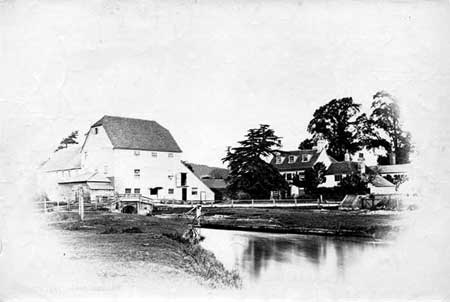
Hambleden Mill, Henry Taunt, 1870
© Oxfordshire County Council Photographic Archive; HT01498
1875: Hambleden Lock, Henry Taunt -

Hambleden Lock, Henry Taunt, 1875
© Oxfordshire County Council Photographic Archive; HT3555
1878: Breakwater below Lock built
1881: George Leslie, "Our River" -
Locks are not very old
institutions on the river, and old people by the river still speak of them as
pound locks, as distinct from the old sluices up which the barges were formerly
drawn by means of windlasses.
At Hambleden,
behind the lock-house, are the remains of the old winch formerly used
here; I was told that the lord of the
manor regularly applies for the hire of the winch from the lock-keeper, to
keep alive an old claim on the Thames Conservancy, though the money is never paid. ...
Miss Stapleton, of Remenham Hill, to whom I am indebted for many interesting stories
about this part of the river, told me of an old man who was once lock-keeper at
Hambleden, named Caleb Gould. When he
came to Hambleden the barges were pulled up by the winch. Caleb, and his son Joseph who succeeded him,
had a large oven at the back of the lock-house, and sold bread to the bargemen
and others. When Miss Stapleton knew
them, the son worked the new pound lock, while the old man used to sit and sun
himself underneath a large lavendar bush, descendants of which still grow in
the lock garden. Caleb wore a coat with
lots of buttons, and ate for his supper every night a dish of onion porridge.
He was hale and hearty to the very last,
every day taking a walk up Hambleden, making a great cross in the ground to
mark where he had been, which crosses were known as Caleb's crosses.
Joseph Gould in after life emigrated with his
family to New Zealand, where they have thrived well.
On the bricks by the side of the lock cottage
door, are the initials C. G., 1777, and below, J. G., 1826.
The oven at the back of the house has lately
been pulled down
1884: Charles Phillis lock-keeper, moved here from Chalmore Hole
(which lock below Wallingford had been finally removed in 1883)
In December Charles was "ordered to Keen Edge Ferry but either did not go or was subsequently reinstated"
Fred Thacker, The Thames Highway vol II p.200, says of the appointment to Hambleden that it was in November 1882,
so perhaps 1884 refers to a reinstatement?
Boatslide suggested.
1886: Hambleden Lock by J. Ashby-Sterry Listen to 'Hambleden Lock'
A CAPITAL luncheon I've had at the Lion,
I've drifted down here with the light Summer breeze;
I land at the bank, where the turf's brown and dry on,
And lazily list to the music of trees !
O, sweet is the air, with a perfume of clover,
O, sleepy the cattle in Remenham meads !
The lull of the lasher is soothing, moreover,
The wind whistles low in the stream-stricken reeds !
With sail closely furled, and a weed incandescent -
Made fast to a post is the swift Shuttlecock
I think you will own 'tis uncommonly pleasant
To dream and do nothing by Hambleden Lock !
See a barge blunder through, overbearing and shabby,
With its captain asleep, and his wife in command;
Then a boatful of beauties for Medmenham Abbey,
And a cargo of campers all tired and tanned.
Two duffers collide, they don't know what they're doing
They're both in the ways of the water unskilled
But here is the Infant, so great at canoeing,
Sweet, saucy, short-skirted, and snowily frilled.
I notice the tint of a ribbon or feather,
The ripple of ruffle, the fashion of frock;
I languidly laze in the sweet Summer weather,
And muse o'er the maidens by Hambleden Lock !
What value they give to the bright panorama
O, had I the pencil of Millais or Sandys !
The lasses with sunshades from far Yokohama,
The pretty girl-scullers with pretty brown hands !
Next the Syren steams in; see the kind-eyed old colley,
On the deck, in the sun, how he loves to recline !
Note the well ordered craft and its skipper so jolly,
With friends, down to Marlow, he's taking to dine.
In the snug-curtained cabin, I can't help espying
A dew-clouded tankard of seltzer-and-hock,
And a plateful of peaches big babies are trying,
I note, as they glide out of Hambleden Lock !
A punt passes in, with Waltonians laden,
And boatmen rugose of mahogany hue;
And then comes a youth and a sunny-haired maiden
Who sit vis-à-vis in their bass-wood canoe.
Now look at the Admiral steering the Fairy,
O, where could he find a much better crew than
His dutiful daughters, Flo, Nina, and Mary,
Who row with such grace in his trim built randan?
I muse while the water is ebbing and flowing,
I silently smoke and serenely take stock
Of countless Thames toilers, now coming, now going,
Who take a pink ticket at Hambleden Lock !
[ It would be nice if W H Smith, First Lord of the
Admiralty, had daughters Flo, Nina and Mary but unfortunately not, his
daughters were Mabel, Emily Anna,
Beatrice and Helen. (See Greenlands,
below) However Ashby-Sterry dedicated his book of Poems - "The Lazy Minstrel" to Mary, Nina and Florence.
The pink ticket was the lock ticket sold at each
lock for pleasure boats - it was valid for a return on the same day ] -

Pink ticket, 1888
1891: The Stream of Pleasure, Joseph & Elizabeth Robins Pennell -
While the water ran out, the lock-keeper came and gave us that curious literary production, a Thames Lock Ticket. It admits you "through, by, or over the lock or weir" for threepence. That is, I suppose, you can go through the lock in Christian fashion, drown under the weir, push and pull over the roller if there is one, or drag your boat round by the shore; but whether you come out dead or alive, for any of these privileges the Thames Conservancy will have its threepence.
So the lock-keeper collected the toll - but locks were also plagued with other less official collectors.

Lock-keeper (handing ticket) "Threepence, please."
Little Jenkins. "Not me: I've just paid that fellow back there."
Lock-keeper (drily). "'im? Oh, that's the chap who collects for the band!"
Locks were originally called 'Pound Locks'. One of Joseph Ashby-Sterry's bon mots was the pun -
Whether bankrupt or not you are still bound to pay threepence in the pound!
1889: Boatslide in existence? Fred Thacker had no knowledge
of it in 1920
1890: 24th December, Charles Phillis, lock-keeper, drowned in the lock, being unable to swim.
1906: Mortimer Menpes, Hambleden -

Mortimer Menpes, Hambleden, 1906
1910: Hambleden in Thames Villages by Charles Harper.
1914-1922: The Belgian painter Nestor Cambier (1879-1957) visited England. (One guesses this may not have been entirely voluntarily? He stayed at Culham Court on the Thames just a mile or so below Hambleden as the guest of Sir Henry and Lady Barber.) He painted this lovely impressionistic view of Hambleden Lock. (My thanks to Ebelien and Noud Koevoets who restored this painting.)

Hambleden Lock, 1914-1922?, Nestor Cambier
1946: Hambleden Weir by Frank Runacres -
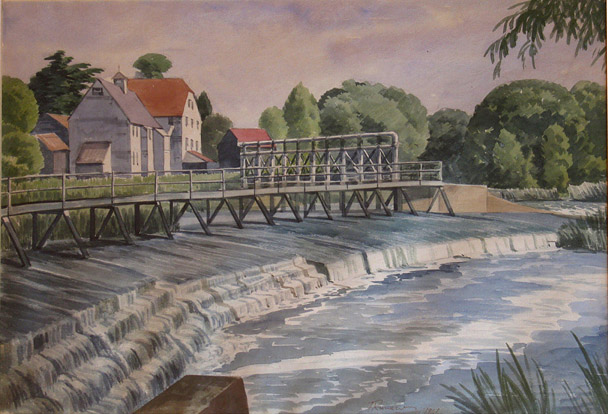
Hambleden Weir, 1946, Frank Runacres
1950: Hambleden Lock in 'Buckinghamshire' by Alison Uttley -
The river, which makes a deep and sudden bend at this point,
can be crossed by a long slender footbridge which twists and
turns on its way from Hambleden to the Berkshire bank. Near
this bank is the lock and the lock-keeper's cottage.
The cottage, with its little garden and lawn, seems to be on an island cut off
from the world amidst this stretch of water. Leaning on the
little bridge opposite the cottage was a comely woman who was
the lock-keeper's wife. We joined her and loitered there, gazing
at the water, watching the three swans which dabbled on the
rippling steps of the sluice.
The sound of the cascading water was
like that of Aira Force in Westmorland. It rang continuously in
our ears.
"I can't sleep when I'm away from it. I miss the noise of
falling water," she told us.
I asked about the flowers which grow in the shallows.
One year, when the Thames was very low and no water flowed
down these "steps," many flowers sprang up there. Seeds were
carried by the waters and left to flower in that dry season. Even
on that day there were water forget-me-nots and loose-strife
and water mints growing on the stones with the water flowing
over them.
The river has a canal cut in it here so that boats can go
through the reaches by the locks without going through the
waterfalls by the mill. In old days, I was told, they had to carry
the boats at this point and of course no large boats could come up
the river.
The lock was clean and fresh as paint. It seemed as if
it were loved and the lock-keeper's cottage was a charming toy
with its garden and hedge and little gate, and its vision of old
china through the open door. Everything was trim and well kept.
Another day I watched motor-launches going through the
lock and the little families on board helped the lock-keeper at
his work. It was fascinating to see the water slowly enter and
the boat rise, and several people leaned against the wall to share
the quiet entertainment.
I went to Hambleden once after a great storm. There was a
spate of brown foaming water which rushed down the wide
sluices with a roar that was deafening. It churned itself with
terrifying force below us as we stood on the bridge. Giant
balsam and feathery rushes waved their long streamers and tawny
flowers in the wind. The swans in the river and the cygnets
actually walked up the stones against the strong flow of water,
planting each foot slowly and firmly, but when they reached the
top they swam away waving their little tails in pride that they
had arrived safely. It was obviously a feat of strength and
endurance and each bird showed intense satisfaction on conquering the difficulty.
2000: Lock rebuilt -
The
reconstruction of Hambleden Lock was necessary to alleviate one of the river's
bottlenecks by increasing the lock's size and because the existing 120 year old
lock structure was in need of major structural repair.
In order
to construct the new lock structure a
temporary
cofferdam had to be installed around the existing lock. During the
first contract period sheet piles were driven on either side of the lock. The
cofferdam was completed a year later, during the second contract period, when
the piles were installed across the head and tail of the lock.
To
ensure that there were no props below ground level to interfere with the lock
construction works 14m long Larssen(6) piles were selected.
The piles' strength meant that they were only
required to be propped at the top. The
initial piles were installed within 4m of the existing lock walls and the
proximity of the lock house to the works necessitated use of a pile driving
method that minimised noise and vibration. To this end a hydraulic pile
pressing system was employed.
The
system was so successful at driving the 14m long piles through 13m of clay and
chalk that the lock was reopened 3 weeks ahead of schedule. In difficult ground
a water jetting lance was fitted to the piles to assist penetration. The noise
levels generated by this pile driving system were less than the background
noise of the weir. The system was also employed to extract the piles with up to
44 being extracted in one day.
2004:-

Hambleden Lock, 2004
Hambleden Weir from a Canoist's point of view -
Looking upstream from the weir pool, from left to right, there is the lock,
followed by a small island; 2 small radials; a long tiered concrete shelf,
the 4 radial gates of the main weir; another long tiered concrete shelf;
2 further radial gates; further shelving and a further, triple, radial.
The weir structure zig zags from one end to the other, at an angle to the river,
and as a result the main weir and radials nearest the lock are both tucked into
corners with limited access from one side.
The water drops a greater height at Hambleden than at Hurley.
The main weir consist of 4 large radial gates, which looking upstream from the weir pool,
can be numbered 1-4 looking from left to right, from the main eddy.
When the weir pool level is low enough and/or the underwater ramps are raised
and at least 1 gate is open, the weir generates a wave train which is
good for slalom training.
Play boaters will however, want to see at least 2 gates open because this is needed
to produce the new Hambleden wave.
The top wave can be up to 30ft wide and 4ft high, depending on the weir pool level
and whether the ramps are raised.
When the weir pool is relatively low and/or the ramps are raised,
the wave can be largely green, at other times the wave can be breaking
and very retentive.
The wave is suitable for the basic moves - front and back surfing and flat spins
and ends and new school moves such as blunts are achievable.
Whilst the wave may not be as good as Shepperton at its best, it is a useful,
less crowded and more user friendly alternative to Hurley.
The other smaller radials are dangerous most of the time - producing retentive stoppers
between the stanchions. However, they do provide useful moving water downstream
for training; and experienced paddlers may find that at certain levels it is possible
to play in the stoppers - but be very careful.
Beware - at certain levels, typically when the weir pool level is relatively high,
the top wave can turn into a very retentive stopper.
Check carefully - it should obvious from the eddy what you are about
to let yourself in for.
Above Hambleden Lock
1829: Just above Hambleden Lock was the start of the first Oxford and Cambridge Boat Race Click for an account on this site
1881: George Leslie, "Our River" -
Behind
Hambleden Lock, in the waters leading to the mill, Mr Schwabe's boat-house, and
little fleet of sailing-cutters may be seen;
the boatman's cottage adjoining was formerly a small inn, and many a
draught of shandy-gaff I have had beneath the little arbour; when this place was shut up some years ago
there was great indignation amongst the local population, and the poisoning of
a vast quantity of pheasants in the preserves belonging to Greenlands, was
supposed by many to have been an act of revenge by some aggrieved parties.
The
punting is not good about here until Temple Island is reached; the tow-path side, of course, is the shortest
course to take, but the ground is much better on the other side up as far as
Greenlands.
From here on upstream watch out (behind you!) for racing rowing craft. They travel more than twice as fast as any launch ought to be moving. The top speed on a Henley Regatta start is well over 13mph. Thames speed limit for powered boats is under 5mph. Keep well clear and be careful not to obstruct them.