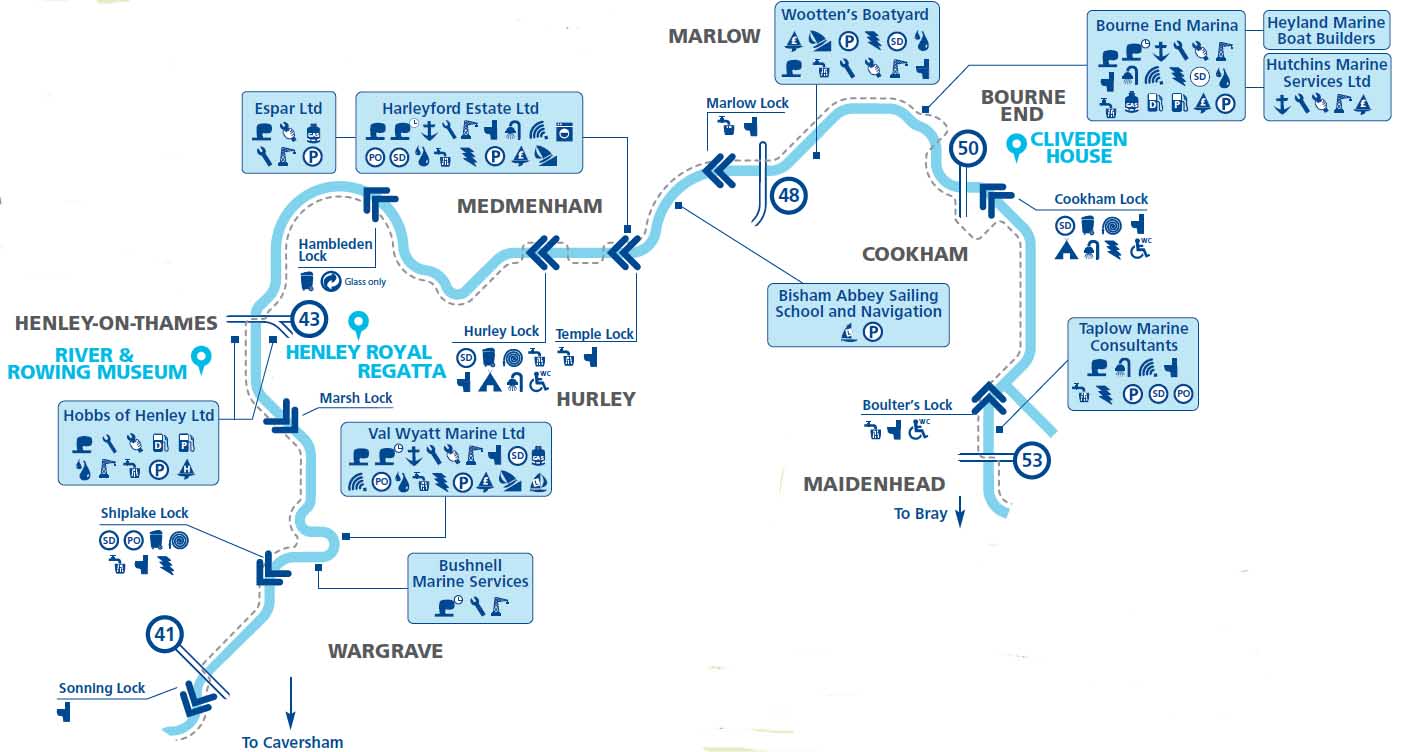
Most disappointingly the Environment Agency does not provide readings for
Hambleden Lock Upstream or downstream - thus making it impossible to calculate conditions in the
Henley Reach (and Hambleden to Hurley)
Marsh to Shiplake,
Marsh to Hambleden, Environment Agency 'Out and About' Guides
Maps
Right Bank, tel: 01491 572992, length: 135'2", width: 21'1"
Marsh Weir for canoists
1404: John Dayton
indicted for not properly maintaining, at Rotherfield Pypard, locks and
winches in aid of the navigation.
(The site
of Marsh Lock might have been counted as in this parish at the time)
1585: Bishop - New Mills, left bank
1715: Overton’s Map – New Mills, left bank
1746: Griffiths – “Mash Lock”
1773: Pound lock
built. The Revd Humphrey
Gainsborough, the artist’s brother, minister of Henley
Congregational Church, was involved.
He was an inventor and friend of James Watt.
1776: Humphrey
Gainsborough died in the Lion Meadow “whilst conversing with some
gentlemen about the locks he had constructed, having about £70 belonging
to that useful work in his pocket.”
1780: Marsh Lock was
decaying fast. The gates want to be new plank’d. The mill stream waste water setting against the eyett below the pound, cut it away in such a manner that a row of piles & rails must be set up, as well to secure the bank as to prevent barges driving against it by the strong current.
1786: Weir “broken down
by ice & water to the extent of 100 foot”.
1787: Poundlock rebuilt
1793: Marsh Lock, Boydell -

Marsh Lock, Boydell, 1793
1794: Rennie –
There are two corn mills on the Berks (right bank) side, and a corn and paper mill on the Oxford side. In the middle is an old flashlock or stanch, the property of Marshall Conway, in very bad repair. There are also two sets of fishing bucks, one the Marshall’s and the other Mr. Stevens; with so many mills and fishing bucks uncontrouled, as they seem to be, one cannot wonder that the water in the pond above should ofte be worked very low.
1813: Lockhouse built
1814: “the entrance to
the Lock being extremely inconvenient and dangerous for barges.”
1823: “Putting up new
bridges over Mr. House’s millstream”
1825: Swingbridge repaired
1843: The Lock was in
very bad condition, and was thought to be on the wrong side of the
river. Navigation into it was
difficult, and in high water dangerous.
(Fred Thacker, 1920, says “Even now it is a troublesome place to
hold up, at either end.”)
Plans
were drawn up, but never executed, for its removal to the left bank.
1867: The flooded state
of the country above Henley, when the
mills stopped working on Saturdays, was complained of.
1870: Mill offered for sale to the Conservancy “for the
improvement of the river” They did not buy.
1877: A boatslide was
ordered but never built.
1879: Conservancy tried
to buy mill. It was not for
sale. A new weir was built.
1878:
Marsh Lock, Henry Taunt -

Marsh Lock, Henry Taunt, 1878
© Oxfordshire County Council Photographic Archive; HT2408
1879: Marsh Mill photo –

Marsh Mill, 1879
1881: George Leslie, "Our River" –
At Marsh
Lock there are two Mills, one on each side, and the opposing currents from
these Mills render the approach to the lock from below always rather difficult.
The
tow-path passes along to the lock, over the weir and mill waters, by a long,
wooden bridge, most picturesque in its line and character, and which I am
grieved to say is all doomed to be removed, as the whole weir is now being
reconstructed.
I think
it is quite possible the construction of this bridge and the arrangements of
the weir and lock were carried out under the direction of a brother of
Gainsborough the artist...
In winter time, when there is a flood, the long line of this bridge and the weir,
as seen from the high ground on the Wargrave Road, is very singular and
striking, especially when the meadows and tow-path are under water...
A
disagreeable smoky chimney spoils the look of the Mill on the Oxfordshire side,
but the other, though lately rebuilt, is by no means ugly; some little outbuildings in red brick above
the weir are not out of harmony with their surroundings, and the long walls of
the Mill garden are suggestive of peaches, nectarines, and all manner of wall
fruit, which the situation and aspect favour in the highest degree.

Horse Bridge, Marsh Lock, George Leslie, 1881
Marsh Lock is a terrible one
to pass through on a Regatta morning. I
shall never forget coming through from Wargrave on one of these occasions. The gates could hardly open on account of the
jam of boats against them, everybody as usual wanting to get in first, the
ladies being by far the most eager and energetic in their endeavours. The whole mass of boats shaped itself into
the form of a huge arrow-head, and right down into the middle of the pack came
slowly but surely a large tug-barge, called the “Spitfire” (since blown-up and
wrecked at Sonning), with a crowd of Reading folks on board at a shilling a
head. As the gates at last opened, the
wedge tightened up, and I was glad to remember that my punt’s sides were inch
stuff, and the oak treads very strong, for I felt and heard the sides of other
boats giving way like baskets, with many an ominous creak; outriggers and
rowlocks got jammed and broken, and amidst cries and vituperation of every
sort, the lock gradually filled. I had
no idea of how many boats a lock would really hold till then. The excitement reached its pitch when the gun
at Henley was heard announcing the start for the first race, and the instant
the lower gates could be opened the whole crowd of boats rushed out, splash,
dash, and away, like school boys out of school.
The return from the Regatta is never so bad, as people leave the
course at various hours, and no one is in any very great hurry, but the poor
lock-keeper has a very hard day’s work.
[ Except that in modern times, on the
Saturday night of the Royal Henley Regatta, after the fireworks,
there is a notorious jam of boats
trying to get through towards midnight.
There are always loud rows and river rage. Stay clear! ]
1883: A new pound lock
was decided upon on the left bank
1883: The Mill was offered for sale; the Conservancy did not buy.
1884: Left bank lock scheme abandoned
1886: The Lock was rebuilt in timber.
1893: Mill still working
1893: Marsh Mill and Bridge, Francis Frith -

1893: Marsh Mill and Bridge, Francis Frith
1895: John Bickerdyke, Thames Rights and Wrongs -
A few years ago a picturesque old weirpool celebrated for its excellent fishing. It was more or less an embankment in the shape of a horseshoe, with openings for water to rush through. A restful thing for the eye, lying between two particularly ugly mills. This weir answered its purpose very well. The Conservators however threw a series of immense iron watergates across from mill to mill, and levelled the old weir, It pleased and brought grist to the millers, because in summer a better head of water could be maintained than with the old weir, which was a little leaky. It immensely benefited the owners of property upstream, because they were less subject to floods than formerly. But neither they nor the millers contributed anything toward the expense of making it. The old inhabitants say there was formerly a way across the river at this spot: along a horsebridge, then over the lock, and on to the road through from the mill yard. But when these alterations were carried out this road was stopped.
1899: A law suit
decided that Warborough millstream, running behind the lockhouse to the
mill, is a private water.
[ BUT WHERE THAMES WATER
FLOWS THERE IS A RIGHT OF WAY – and it flows there – of course there is little
point going the few yards on it and certainly no powered craft should attempt
it, but the principle remains. Perhaps a lawyer could explain that decision?
The Hedsor Water case (2004/5) has recently been decided
the other way – and quite right too!]
Part of what the 1885 Act said was -
1. It shall be lawful for all persons, whether for pleasure or profit, to go and be, pass and repass, in boats or vessels over or upon any and every part of the River Thames, through which Thames water flows, between the Town of Cricklade and Teddington Lock, including all such backwaters creeks side-channels bays and inlets connected therewith as forms parts of the said river within the limits aforesaid. ...
1955: Marsh Lock, Francis Frith -

1955: Marsh Lock, Francis Frith
1955: Above Marsh Lock, Francis Frith -

1955: Above Marsh Lock, Francis Frith
Park Place
On the right bank, a quarter of a mile north east of Marsh Lock.
1792: Picturesque Views on the Thames, Samuel Ireland -

Park Place, Samuel Ireland, 1792
1793: Scene at Park Place including the Druid’s Temple, Boydell -

Scene at Park Place including the Druid's Temple.
June 1, 1793 J. Farington R.A. delt.
J.C. Stadler sculpt.
(Published) by J. & J. Boydell,
Shakespeare Gally. Pall Mall & (No. 90) Cheapside (London).
1801: The Beauties of England and Wales -
PARK PLACE, THE residence of the Earl of Malmsbury, is Situated one mile south-east of Henley.
The many interesting objects concentrated in this domain, are calculated to excite even the most latent energies of poetic description ;
yet none of the magic tints which fancy blends to embellish the creations of imagination, are requisite to give lustre to the picture.
Beauty, grandeur and variety, are the characterizing features of this estimable seat,
the grounds of which display as much boldness of composition as any on the banks of the Thames.
The steep sides of the hills, with their chalky precipices, are overhung with grand masses of stately beech interspersed with evergreens,
which extend to the margin of the stream, and, from various points of the landscape, appear like an immense verdant amphitheatre.
The projecting lawns correspond with the sublimity of the contiguous scenery, and unite in forming a diversity of rich and beautiful prospects.
This estate was purchased of the widow of the late Field Marshal Conway, by the present noble resident, in the year 1796.
The General expended considerable sums in improving and embellishing the grounds ;
but the principal alterations of the house have been made since it became the property of the Earl,
under whose direction the arrangement and construction of the rooms have been greatly altered,
and elegantly decorated from the designs of Mr. Holland, the architect.
This mansion is situated on the brow of a lofty range of hills, that accompanies the windings of the Thames for several miles ;
and the spot on which it stands is nearly three hundred feet above the level of the water, being judiciously sheltered from the winds by extensive plantations.
The building is composed of brick, cased with a yellowish stucco; and, though not externally grand, is highly interesting,
from the taste and elegance exhibited in the interior.
The library is splendidly furnished, and stored with a profusion of choice books, the chief of which were collected by the late Mr. Harris, (father to the Earl,)
who was esteemed by all the literati of the day for his erudition and refined taste.
This selection has been considerably increased by his son, whose additions have been principally made from the classics and historians.
The taste of this nobleman for literature is displayed by almost every room in the house being filled with select volumes.
This mansion contains several good paintings by ancient and modern masters.
...
Though the house, as we have already stated, is not without attractions, yet the most prominent feature of Park Place is the beautiful scenery of the grounds,
which are diversified with a continued succession of lofty eminences and low vallies.
The woods partake of forest wildness, and being intermixed with shrubberies, produce the most picturesque and beautiful views.
Many of these scenes would delight the mind of a Salvator, and many others a Claude might in vain attempt to copy.
Some of them command an unbounded horizon, and present all the variety of English landscape.
On the east of the mansion is a garden inclosed and laid out according to the French taste;
and near this is the aviary, designed on a peculiar plan, and furnished with a beautiful selection of the feathered race;
among which the silver pencilled and gold Pheasants are particularly deserving of admiration, for their pleasing forms and elegant plumage.
A winding subterraneous passage, nearly 170 yards in length commencing in a wood on the summit of a hill near the aviary,
leads to a fine valley, planted on the borders with cypress and other trees.
Here a grand colonnade, representing a Roman amphitheatre falling into decay, and majestic even in ruin, presents itself.
This is executed in a manner far superior to most ornaments of this kind; and its secluded situation,
and mouldering ivy-crowned walls, render it peculiarly picturesque.
Descending the valley towards the Thames the path winds under a large arch, curiously constructed with natural stones,
of vast dimensions intermingled with the enormous blocks of massive wall brought from Reading Abbey.
This fabric, interesting for its singularity, seems a very romantic object, when viewed from the water on the opposite bank of the river.
The High road which passes over the arch, is excluded from sight by shrubberies and plantations;
and through that judicious management is prevented fom having a displeasing effect.
On a hill, near this structure, is an elegant cottage, whence the views are particularly fine.
On the west the Thames glides in full stream, washing the skirts of the wood toi the whole extent of the grounds.
Towards the east the meanderings of the river are indistinctly seen through the verdant scenery that adorns
the eminence on which the cottage is situated.
On the north the Church of Henley, and the woody hills of Oxfordshire in the distance, constitute an agreeable prospect.
From the river banks in this quarter, a narrow pass, overhung with trees, leads to a chalk cavern of large dimensions.
Proceeding southwards, a solitary willow walk, on the borders of the stream, conducts the wanderer's feet
to an elegant tomb of white marble, composed in the Roman style and perfectly in unison with the sequestered and lonely spot
on which it stands.
At some distance is a romantic arch, constructed with rude stones, and rendered pleasing by the variety of its verdant accompaniments.
The high grounds on the north towards Henley are crossed by a noble terrace of great length, whence a complete birds'-eye view
of the river, the town and the surrounding country, enchants the sight of the spectator.
Beyond the terrace is a pleasant valley, consisting of about twenty acres, called the Lavendar Farm, exclusively appropriated to the
cultivation of that herb, and separated by a line of shrubs from a steep and rugged ravine, where the high road formerly ran;
the sides of which exhibit a variety of rude and broken scenery.
Near the bottom is a small stone house, much admired for its elegant simplicity.
These different objects form a landscape of very distinct character from any of the prospects before described.
On a well-chosen eminence, near the southern quarter of ths ornamented grounds, stands a curious vestige of the manners of antiquity.
This is denominated a DRUID'S TEMPLE, and was presented to General Conway by the inhabitants of the isle of Jersey,
as a testimony of the respect and gratitude due to his vigilance as a governor, and to his amiable qualities as a man.
This invaluable gift was accompanied by an appropriate and forcible inscription, which we shall transcribe in the words of the original.
Cet ancien Temple des Druides
decouvert le 12me. Aout, 1785,
sur le Montagne de St. Helier
dans l'Isle de Jersey ;
a été présenté par les Habitans
a son Excellence le General Conway,
leur Gouverneur.
Pour des siecles cache, aux regards des mortels,
Cet ancien monument, ces pierres, ces autels,
Ou le sang des humains offert en sacrifice,
Ruissela, pour des Dieux, qu'enfantoit le caprice.
Ce monument, sans prix par son antiquité,
Temoignera pour nous à la postéritée,
Que dans tous les dangers Cesaréee* eut un père,
Attentif, et vaillant, genereux, et prospere:
Et redira, Conway, aux siécles àvenir,
Qu'en vertu du respect dû à ce souvenir,
Elle te fit ce don, acquis àa ta vaillance,
Comme un juste tribut de sa reconnoissance.
The stones which compose this temple are forty-five in number, and were all so carefully marked when taken down, as to be re-erected
on this spot in their original circular form. They were discovered in the summer of the year 1785, on the summit of a rocky hill, near the town of St. Helier,
by some workmen who were employed to level the ground as a place of exercise for the militia, and before that time were entirely hidden with earth,
which appeared raised in a heap, like a large barrow or tumulus. The circumference of the circle is sixty-six feet ;
the highest of the stones about nine. They are from four to six feet in breadth, and from one to three in thickness.
The entrance or passage faces the east, and measures fifteen feet in lenglh, five in breadth, and four in height.
The inside contains five cells, or cavities, varying in depth from two feet four inches to four feet three inches.
The coverings of these cells and of the entrance are of stones from eighteen inches to two feet thick.
Within this temple two medals were found : one of the Emperor Claudius ; the other so obliterated as to be unintelligible.
The accounts of the history and antiquities of Jersey are very imperfect, yet it seems probable, that it was once particularly the seat of Druid worship.
So lately as the year 1691, when Mr. Poindextre wrote some tracts concerning it, there were no less than fifty assemblages of rude stones,
which that gentleman considered as Druid temples or altars; yet nearly the whole of these antique memorials have since been demolished.
When, or by whom, the present structure was covered up is unknown ; but it is supposed to have been buried by the Druids themselves,
to preserve it from the violence and profanation of the Romans.
All the stones with which it is formed are as rough and unhewn as when taken from the quarry.
This curious structure seems to be a combination of the Cromlech, the Kistvaen, the stones of Memorial, and the pure druidical, or bardic Circle.
It is a very singular relict of British antiquity, and highly deserving of preservation as a vestige of the customs of remote ages.
Park Place includes an area of 400 acres; an extent of ground, perhaps, that comprises as great a variety of interesting prospects,
as any of similar limits in the kingdom.
1811:

Park Place, 1811
1817: The Druid's Altar at Park Place, Henley/Seat of the Earl of Malmesbury, Cooke’s Views of the Thames

Druid's Altar at Park Place, Henley
Seat of the Earl of Malmesbury. Drawn by the late Wm Alexander F.S.A. of
the British Museum. Engraved
by George Cooke. Jan 1, 1817.
1821: Park Place near Henley, Seat of the Earl of Malmesbury, Cooke’s Views of the Thames -

Park Place near Henley
Seat of the Earl of Malmes-bury. Drawn by P. Dewint. Novr 1, 1821.
1870: (from From Berkshire by Nikolaus Pevesner, 1966) -
The present house is by Thomas Cundy, 1870, in a rather dreary French Renaissance Style with a tower over one corner of the facade and Pavallion roofs. This house takes the place of that of the Conway family.
1881: George Leslie -
Once
above Marsh Lock the whole character of the river is changed, a steep hill and
cliffs is on the left hand, open meadows and poplars on the right, and a great,
calm, wide reach of deep water and sluggish stream, partaking of the character
of a small lake; the punting is very
bad; the tow-path side is fringed all
along with soft green sedges and persicaria, the sure indicators of mud.
The wooded side, though the bottom is hard,
is very deep, and the projecting willows make it rather awkward, so if the wind
is fair, I should have no hesitation in setting sail.
The grounds of Park Place come
down to the river’s edge, just above the Mill garden, passing underneath the
roadway by a picturesque arch, through which a glimpse of what
is known as Happy Valley is obtained.
The Wargrave Road,
which runs through the woods and over the arch, is the one traversed by Mr.
Black’s phaeton on its tour, and a prettier, shadier drive does not exist
anywhere.
The grounds of Park Place have
been divided into two parts since Walpole’s
time, and on the second half a house called Templecombe has been erected.
In the grounds of Park Place is a Druid’s Temple,
the stones of which were brought from Jersey and presented to General Conway.
[ I know its valuable heritage and all that - but, is it the planners or the County Council or the landowner
to blame for the retention of the happy valley narrow bridge here which causes such danger
and delay to motorists on the Henley Wargrave Road?
It should not be too difficult to rebuild that bridge at double width to
solve that problem? (The underneath of
the bridge can just be seen in the Frith photo of the boathouse below)
1881: George Leslie -
The well-known boat-house with its little saint, though rather artificial, is very pretty, and the whole bit would be quite charming if it were not for an ugly trespassers’ board.
[ I love George Leslie’s ability with language. Makes you wonder what might happen to more attractive trespassers!]
UGLY TRESPASSERS WILL BE PROSECUTED ...
1893: Boathouse above Marsh Lock, Francis Frith -

1893: Boathouse above Marsh Lock, Francis Frith
1881: George Leslie -
There are several reaches of the river in which chalk cliffs rise on the banks, as those at Park Place do; at Harleyford, Quarry Woods, Hartswood, Pangbourne, Shiplake, and in parts of Cliveden. The chalk cliffs give great variety to the beauty of the scenery, but at none of these spots is their arrangement so perfect as at Park place; here there is a sort of undercliff between the base of the chalk and the river, which is covered with delicious foliage, a number of most graceful ash trees supplying the greatest amount of the beauty. These trees are rather delicate in our climate; they likewise require a good supply of moisture, and here in the snug shelter of the chalk cliffs, with the rich soil beneath them, and the water never failing their roots, they grow in their utmost luxuriance. From the Wargrave Road above the cliff I love to look over and down on to the tops of these trees, and realise the beautiful way that foliage must appear to birds. The ash was Constable’s favourite tree; the exquisite grace of its branches, the sad poetic tone of its foliage, and the pale olive grey of its bark, rendering it very dear to him.
1884: The Upper Thames, Harpers New Monthly Magazine -
... like a calm inland lake, bordered on one side with woodland heights,
and on the other by miles of verdant meadows.
We pause to take note of a grand cluster of beeches that are repeated in the silent river below,
repeated with the last rays of the setting sun gilding their autumn-tinted branches,
while the leafy heights of the grounds of Park Place make a long line of
gold and green and red as far as the eye can see.
Above us a clear sky, with great sun-bronzed clouds sailing away eastward,
and a long line inn of crows making for some distant rookery.
Suddenly, close inshore, a shoal of tiny fish are leaping in and out of the water,
like, on a small scale, flying-fish at sea.
They might be suspected of a joyful demonstration in thus challenging the golden beams of the sun,
but they are, in their little way, engaged in a tragedy rather than a comedy.
It is a Thames pike hunting his evening meal that excites these tiny inhabitants
of the river to this somewhat unusual demonstration.
1949: Park Place -

Park Place in 1949
(Upstream to Hennerton Backwater)
Estuary
PLA
QEII Br
Barrier
Tower Br
Custom Ho
London Br
; Frost Fairs
Cannon St Rb
The Great Stink
Southwark Br
Millenium Br
Blackfriars Rb
Blackfriars Br
Waterloo Br
Charing Cross Rb
Westminster Br
Lambeth Br
Vauxhall Br
Victoria Rb
Chelsea Br
Albert Br
Battersea Br
Battersea Rb
Wandsworth Br
Fulham Rb
Putney Br
Hammersmith Br
Barnes Rb
Chiswick Br
Kew Rb
Kew Br
RICHMOND
Twickenham Br
Richmond Rb
Richmond Br
TEDDINGTON
Kingston Rb
Kingston Br
Ditton Slip
Hampton Br
MOLESEY
SUNBURY
Walton Br
Desborough Cut
SHEPPERTON
Chertsey Br
CHERTSEY
M3 Br
Laleham Slip
PENTON HOOK
Staines Rb
Staines Br
Runnymede Br
BELL WEIR
Magna Carta Is
OLD WINDSOR
Albert Br
Datchet
Victoria Br
Black Potts Rb
ROMNEY
Eton
Windsor Br
Windsor Rb
Windsor Slip
Elizabeth Br
BOVENEY
Dorney Lake
York Cut
Summerleaze Fb
MonkeyIsland
New Thames Br
BRAY
Bray Slip
Maidenhead Rb
Maidenhead Br
Below Boulters
BOULTERS
Cliveden
Hedsor
COOKHAM
Cookham Slip
Cookham Br
BourneEnd RFb
Quarry Woods
A404 Br
MARLOW
Marlow Br
Bisham
TEMPLE
HURLEY
Medmenham
Culham Ct
Aston Slip
HAMBLEDEN
Temple Is
Fawley Ct
Remenham
Regatta
Phyllis Ct
Henley Slip
Leander
Red Lion
Henley Br
Angel on Br
Landing
Hobbs Boatyard
Hobbs Slipway
MARSH
Hennerton
Bolney
Wargrave
Shiplake Rb
R.Loddon
SHIPLAKE
Sonning Br
SONNING
Dreadnought
K&A Canal
CAVERSHAM
Reading Br
Caversham Br
Reading Slip
Purley
MAPLEDURHAM
Hardwick Ho
Whitchurch Br
WHITCHURCH
Hartswood Reach
Gatehampton Rb
Goring Gap
Goring Br
GORING
Swan
CLEEVE
Moulsford
Moulsford Rb
Papist Way Slip
Winterbrook Br
Wallingford Br
BENSON
Shillingford Br
R.Thame
DAYS
Burcot
Clifton Hampden
Clifton Church
Clifton H Br
Barley Mow
Long Wittenham
CLIFTON
Appleford Rb
Sutton Courtenay
Sutton Br
CULHAM
Culham Cut Fb
Abingdon Slip
Abingdon
Abingdon Br
ABINGDON
Nuneham Rb
Nuneham
Nuneham Park
Radley Boats
SANDFORD
Rose Island
Kennington Rb
Isis Br
Iffley Mill
IFFLEY
Oxford Rowing
Isis
Donnington Br
Riverside Slip
Boathouses
Punting
Lower Cherwell
Upper Cherwell
Islip
Head of River
Salters Steamers
Folly Br
Bacons Folly
Oxford Fb
Osney Fb
Weir stream
Osney Rb
Bullstake Stream
Osney Marina
OSNEY
Osney Br
Four Rivers
OLD RIVER
CANAL
Medley Weir Site
Medley Fb
Bossoms
Perch
Trout
GODSTOW
Godstow Nunnery
Godstow Br
Thames Br
KINGS
River Evenlode
EYNSHAM
Swinford Br
Oxford Cruisers
PINKHILL
Farmoor
Stanton Harcourt
Bablock Slip
Arks Weir Site
NORTHMOOR
Harts Fb
//Rose Revived
Newbridge
//Maybush
River Windrush
below Shifford
SHIFFORD
Shifford Fb
Tenfoot Fb
Trout Inn
Tadpole Br
RUSHEY
Old Mans Fb
RADCOT
Radcot Cradle Fb
Swan Inn
Radcot New Br
Radcot Old Br
GRAFTON
Eaton Hastings
Kelmscott
Eaton Fb
BUSCOT
Bloomers Hole Fb
Trout Inn
St Johns Br
ST JOHNS
Halfpenny Br
Marina Slip
LIMIT
Inglesham
Hannington Br
Kempsford
Castle Eaton Br
Marston Meysey
A419 Br
Cricklade
SOURCE?
THAMES HEAD
SEVEN SPRINGS