Below Sonning Bridge I once had a problem with an aggressive swan,
which was actually attacking a narrow boat steerer when I first saw it.
It soon decided that I, standing on a punt, was easier game.
Swans are generally shy, unintelligent - but they can be macho ...
Jerome K Jerome's heroes had problems with swans near here.
Sonning on Thames website
On the downstream side of Sonning Bridge, is, or was, a puzzling sight. A common enough object it might seem until you think about it!

Post box on Sonning Bridge.
It seems to me a splendid example of installation art.
A similar post box, also in a totally unusable position, appeared on the railway wall just below Purley.
The name Uri Geller may be in the frame? See Sonning Great Court
1125: MacKenzie, Reading Abbey: "wooden Saxon Bridge".
A strong argument for the antiquity of the bridge is that Sonning is more or less the only place on the Thames
to have a single identity embracing both sides of the river.
[ The following places linked by a bridge all have separate identities:
Windsor / Eton; Reading / Caversham; Pangbourne / Whitchurch; Streatley / Goring; Osney / Oxford ]
1530: Leland: A tymbre bridge.
1567: Sonning Bridge rebuilt
1604: New Bridge?
1775-80: New brick Bridge
1792: Picturesque Views on the Thames by Samuel Ireland -

Sonning Bridge by Samuel Ireland, 1792
View of Right bank from left bank downstream of bridge
SUNNING Bridge is a plain modern [ in 1792 ]
structure of brick, well adapted for convenience
and durability. The annexed view
was taken from below the bridge, as the objects there combined most happily to
afford a picturesque landscape. The house, which
appears over the bridge, is the residence of
Lady Rich, whose family has long occupied
this spot.
THE village of Sunning is agreeably situated on an easy ascent on the banks of the
Thames, and is of great antiquity, it was
formerly the see of a Bishop, whose diocese
included the counties of Berks and Wiltshire. The see was afterwards removed to
Sherbourn, and thence translated to Salisbury, whose Bishop is now Lord
of the Manor of Sunning, and formerly had a palace there.
1831: Sonning Bridge closed for 5 days for repair
1859: The Thames, Mr & Mrs Hall
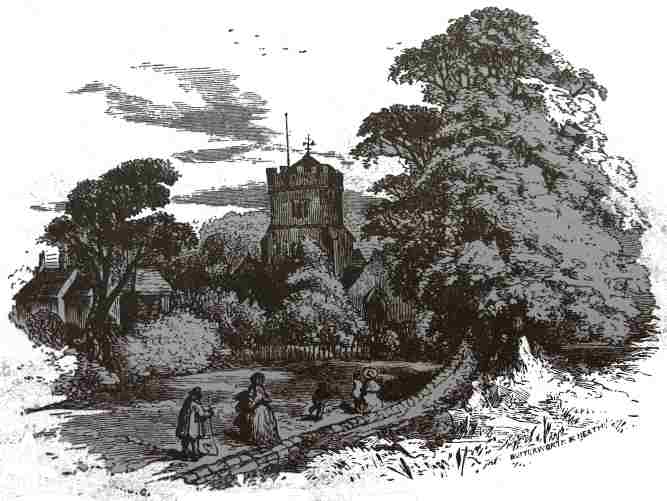
SONNING CHURCH
[from Caversham Lock going downstream] the banks are flat and tame, until we come in view of Sonning Park, and pass underneath the woods which overhang the river. The church and village of Sonning are very simple, hut highly picturesque, — the former is venerable from antiquity, but exceedingly neat and well kept; the latter is clean, neat, and sufficiently aged to retain many of the best characteristics of its "order", which, unhappily, are fast decaying throughout England. It is described by Leland as "an upland town, set on fair and commodious ground, beneath which the Tamise runneth in a pleasant vale." A handsome bridge of brick connects it with the opposite side: many of the cottages are covered with climbing plants — the old honeysuckle, the time-honoured jasmine, and the sweet clematis, mingled with the more recent acquirements of simple florists of humble homes.
1859: A Memoir of the late Rev George Armstrong -
... Hard by the park wall, a little to the right, some irregular cottages and picturesque gables,
with windows opening on hinges, and bright as hands could make them,
furnished with muslin blinds and adorned with fuschias, scarlet geraniums, &c,
announced to me that I was at the entrance to Sonning.
Walking on a little, I asked for the post-office: it was close at hand.
'Pray which is the residence of Mr. E. F ? Perhaps you can inform me.'
'O yes; it is on the other side the bridge, among the first houses you come to.
Your nearest way will be to turn back and pursue the park wall till you come to the churchyard;
passing through which you will presently come to the bridge.'
I followed my instructions, gathering increased delight at every step I took.
The churchyard of Sonning, with its old village church and ivy-mantled tower,
dividing the park from the village, taking all its accompaniments of antiquity, retirement, sloping grounds,
stately timber and noble river, the Thames, quietly skirting it on one side,
is certainly as picturesque as any to be found in England, or to be fancied by the most lively imagination.
It was superlative.
But where was the promised bridge? I was now past the churchyard, and could not see it;
nevertheless, I was close by it; a sharp turn to the left revealed it, and another scene of witcheries.
Beyond it, I descried the houses, where I was to find my friends;
but on the hither side - first the park and church which I had just left -
then the pretty and irregularly-dispersed village tenements, jutting down towards the river,
all backed by a sheltering array of stately wood, every tree of which might be a study for the artist.
And now on the bridge, the eye, directed to the left, sees a small mill on the other side;
the wheel was busy, and the waters it had parted with were in foam, rushing towards the bridge;
it gave just enough of animation to a scene which, without it, was almost too quiet, too serene.
The little mill had a farm-house attached to it, with all the pleasant features of rural life about it.
But the object most attractive was, first at the door of the mill, a large waggon, with yellow body and red wheels,
laden with sacks of flour piled high upon it, while the noble team of horses, which were to bear it away,
large, fat, sleek and black, were enjoying their leisure in feeding on a truss of hay,
under the shade of an ancient walnut-tree, a little distance off in the fore-ground.
The autumnal tints of the walnut leaf were delightfully vivid, and, touched by the evening sun,
gave additional brilliancy and intenser harmony to the whole of this enchanting little landscape.
Could nature have furnished a scene more rich or more perfectly grouped?
But rapt as I was, it was necessary to break the spell, and move I must.
I had not far to go or long to seek before the hearty voice of my excellent friend E. F. was ready to hail me.
He and his good wife, four daughters and three sons, had for some weeks been occupying a crazy old cottage
of a couple of stories high, with hardly an even floor or a straight wall,
and with only such questionable furniture as could be suitably seen in a tenement so rough, wild,
odd and out-of-the-way; yet it was good to be there, right pleasant to meet with such a merry,
rattling, hearty greeting.
Mr. F. loves river scenery, and every summer sets himself down on the banks of his favourite Thames,
at any place forty miles up or down, in the neighbourhood of Reading, where an empty house,
which no one else would think of, may be had, and which a country upholsterer, a faithful retainer of his,
furnishes for the season, in such rough and cheap style as he and his joyous family would prefer
to all the grandeur of Chatsworth House or Windsor Castle.
Here was I, but what was to be enacted first?
'Why didn't I come sooner? They expected me to their early dinner.'
'Couldn't help it.'
'Well, must make the best of our time.'
'Maria, get up some dinner in all haste, for Armstrong must have a row on the river before the evening closes in.'
'Nay,' said I, 'the river first, and the dinner after.'
'Oh, very well, agreed.
Harry, my boy, carry down the cushions; and you, Tom, the awning, in case of a shower;
I'll see to the oars.'
No sooner said than away we went, and after some baling out and other adjustment, we were on board.
I was to see some favourite reaches of the river, which our friend had sketched or was sketching;
at every pull of the oar, some new object or varied feature, that willow, that lock, that tree,
that pleasant grass lawn, that beautiful tint, heightened by alternating light and shade, were ever such sedges?
and even that river-weed tangling with the oar, had not it too its beauty for the eye of my artist friend,
aye, and even for mine, who had learned from him still more to admire and love even
commonest things in this store-house of rude, undressed, quiet nature.
But the navigation was obstructed by something more impracticable than the weeds, we had come to a weir;
if, however, rather impracticable to the boat, it was not so to us. Out we got, and, landing on the nearest bank,
were quickly in another boat, which enabled us to explore some further but similar beauties.
But I must own to having been particularly interested in one part of the river when we stood again upon the bank;
it was one end of the weir, where was a sluice-gate, on either side of which Mr. F. and his boys
were in the habit of taking a plunge every morning before breakfast.
If they liked a quiet plunge, then into the deep, deep water above the weir;
but if a conflict with the foaming element just after it had leaped from the top to the bottom of the weir
on the other side was more to their fancy, then into that cauldron they plunged
from outside of the sluice-gate, with plenty of depth to receive them,
and the amusement besides of buffeting with the angry waters,
which carried them away to the quieter part of the stream. "Was not this delightful?"
Well, it was now wending towards dusk, and my dinner had yet to be disposed of;
so hurrying back to our original point of embarkation, again we were at the cottage
and very soon I was at my repast; rough it was, like everything else within the influence of this curious place,
but plenty of it, and an appetite like that of one of the river pike to do it honour.
But the sauce next to this most piquant, was the chat of mine host,
who sat by me, and by his exhilarating talk and excellent wine withal, of which I sparingly partook,
helped to bring to its close one of the most charming days of friendly and rational enjoyment I ever experienced.
1895: Sonning Bridge, Henry Taunt -

Sonning Bridge, Henry Taunt, 1895
View of LEFT bank from downstream of bridge
© Oxfordshire County Council Photographic Archive; HT6885
1902: The old wooden Sonning bridge over the backwaters, just before it was replaced -

The Old wooden, about to be demolished, Sonning Bridge, with the current stone bridge beyond, 1902
1902: The Sphere -
The proposal of the Oxford County Council to replace the old bridges at Sonning by steel and iron structures has roused the opposition of lovers of the Thames. The "Times", which rarely touches matters affecting the provinces, has devoted a column of protest to the subject, and Mr G D Leslie R.A. has written a strong letter pointing out that traction engines are destroying all the beautiful old bridges in the country
1910: Vanishing Britain, P H Ditchfield -
The passing away of the old bridges is a deplorable feature of
vanishing England. Since the introduction of those terrible
traction-engines, monstrous machines that drag behind them a whole
train of heavily laden trucks, few of these old structures that have
survived centuries of ordinary use are safe from destruction. The
immense weight of these road-trains are enough to break the back of
any of the old-fashioned bridges. Constantly notices have to be set up
stating: "This bridge is only sufficient to carry the ordinary traffic
of the district, and traction-engines are not allowed to proceed over
it." Then comes an outcry from the proprietors of locomotives
demanding bridges suitable for their convenience. County councils and
district councils are worried by their importunities, and soon the
venerable structures are doomed, and an iron-girder bridge hideous in
every particular replaces one of the most beautiful features of our
village.
When the Sonning bridges that span the Thames were threatened a few
years ago, English artists, such as Mr. Leslie and Mr. Holman-Hunt,
strove manfully for their defence. The latter wrote:--
The nation, without doubt, is in serious danger of losing faith in the
testimony of our poets and painters to the exceptional beauty of the land
which has inspired them. The poets, from Chaucer to the last of his
true British successors, with one voice enlarge on the overflowing sweetness of
England, her hills and dales, her pastures with sweet flowers,
and the loveliness of her silver streams. It is the cherishing of the
wholesome enjoyments of daily life that has implanted in the sons of England
love of home, goodness of nature, and sweet reasonableness, and has given
strength to the thews and sinews of her children, enabling them to defend her land,
her principles, and her prosperity.
With regard to the three Sonning bridges,
parts of them have been already rebuilt with iron fittings in recent years,
and no disinterested reasonable person can see why they could not be easily made
sufficient to carry all existing traffic. If the bridges were to be widened
in the service of some disproportionate vehicles it is obvious that the traffic
such enlarged bridges are intended to carry would be put forward as an argument
for demolishing the exquisite old bridge over the main river which is the glory
of this exceptionally picturesque and well-ordered village;
and this is a
matter of which even the most utilitarian would soon see the evil in the diminished
attraction of the river not only to Englishmen, but to Colonials and Americans
who have across the sea read widely of its beauty. Remonstrances must look ahead,
and can only now be of avail in recognition of future further danger.
We are called upon to plead the cause for the whole of the beauty-loving England,
and of all river-loving people in particular.
1923: Ward Lock, The Thames -
Sonning Bridge is, or was, said to be one of the earliest on the river.
Really there were two, one of mellow red-brick, starting from the Berkshire side,
which remains, and one supported by wooden piles, distinctly picturesque,
starting from the Oxfordshire side.
The latter, being considered unequal to the needs of modern traffic [1923], was replaced
by the modern structure, in spite of vehement opposition in the press,
early in the present century [1900s].
It was a loss, a great loss; but Sonning is still an incomparably lovely place.
1929: A Thames Survey -
Sonning Bridge is in two portions:
that over the main stream near the village is one of the most beautiful across the Thames
and should be preserved at all costs, as it is so eminently in harmony with the character of the village,
and, seen from the Oxfordshire bank and towpath, with the church and village street as background,
it forms an entrancing picture of river-scenery. The bridge is mediæval, built entirely of brick
of good colour and texture, and consists of one central semi-circular arch for navigation
and eight smaller semi-circular arches. The structural condition appears sound, and although
the bridge is narrow, it is adequate for the present needs of traffic.
Across the northern stream, below Sonning Mill, in place of the ancient and picturesque wooden bridge,
which survived until recently, there now exists a modern iron bridge,
simple and unobjectionable in form, except that its brick piers and coarse details
have been carelessly designed and could be much improved.
1995: Sonning Bridge reinforced by chemical injection. (Cintec)
1996: The Backwater Sonning Bridges were rebuilt (replacing the 1902 bridges)
1999:-

Sonning Bridge, 1999

1881: George Leslie, "Our River" -
The view of the church and bridge from the tow-path
is one of the best composed groups for a landscape painter I ever saw.
Mr. Keeley Halswelle painted a small picture
of this bit, which hung for some time at the Arts Club, and I admired it very
much; the whole
group was given without any alterations, and one could not have desired a line
away or a single mass added to.
There are two bridges at Sonning which connect
the island of Aberlash House and mill with the main
land on either side; an old brick one on
the left, and the other a rambling wooden one over the weir water, which above
this bridge is very broad and shallow, and filled with watercress and
forget-me-nots.
The stream beyond the
brick bridge is quite different in character;
it is very sluggish and solemn, low
down in its banks, and overhung with evergreens on the Aberlash side.
There is generally some difficulty in
obtaining a bed at the White Hart, and if the little French Horn Inn is also full,
there is nothing for it but to sleep in the Butchers Arms up the village,
which sounds worse than it really is, as
the accommodation is not bad there.
I generally manage to lunch at the White Hart if possible, as the coffee-room
with its polished tables and pretty bow window is most inviting, and the little
tables out in the garden beneath the arbours are equally pleasant if the
weather is fine; when
we lived at Wargrave, this was a great place to come for tea and gooseberries.
Mr. Marks and I, on the visit which we paid to Wargrave, one fine October,
rowed up to Sonning, and had the pleasure of witnessing a grand wedding
there; the miller's daughter from
Aberlash House was the bride, and the bridge was decorated with arches of
flowers and evergreens. We stood beside
the west porch of the church amongst the crowd, and saw the wedding party pass
in; the floor of the porch was ankle
deep with flowers, scattered from the baskets of the village maidens, the bells
ringing merrily and the sun shining, as it always should on these occasions.
1906: G.E.Mitton -
THERE are certain notable details of the riverside
which stand out in the mind after the rest have been merged in mere
general remembrance of lazy happiness. In these we may include the backwater at
Sutton Courtney, the woods at Clieveden, the Mill at Mapledurham, and the Rose
Garden at Sonning.
Roses grow well all along by the river, but nowhere so well as they do at Sonning,
and the rose garden forms an
attraction which draws hundreds to the place. Yet Sonning has other attractions
too; it is very varied and very pretty. When one arrives
at it first, perhaps coming upstream, one is rather perplexed to discover the
exact topography. We round a great curve which encloses an osier bed; here, in
early spring, the osiers may be seen lying in great bundles, shaded from
olive-green to brown madder. Then we see some green lawns and landing places
beneath the shadow of a fine clump of elms, and catch sight of the lovable old
red-brick bridge, with its high centre arch, spanning the stream. But there is
another bridge, a wooden foot-bridge, which also spans the stream, at right
angles to the other, and peering through beneath this we can see the
continuation of the red brick one in a new iron structure, which stretches on
right up to the neat flower beds of the French Horn Hotel.
The truth is, the
river suddenly widens out here into a great bulge, and in the bulge are several
islands, on one of which are a mill and a house and several other things,
not to forget a charming garden. It is the river channel between this island
and the bank that the first
bridge, the old one, spans.
And what a view it is! Above the bridge can be seen
rising the little grey church tower.
On one side is the White Hart Hotel, with
its warm tone of yellow wash, its red tiles and its creepers, and above all its
famous rose garden.
In the foreground is a willow-covered ait placed in exactly
the right position. It is a perfect picture. But yet this is not the best side
of the bridge. The other side is better; for here, to resist the flow of the
current, the builders placed the buttresses which emphasise the height of that
centre arch; buttresses now capped with tufty grass and emerald moss, and from
the crevices of which spring clumps of yellow daisies, candytuft, wallflower,
hart's-tongue fern, and other things. In the bricks all colours may be seen,
after the manner of worn bricks, not even excluding blue.
The mill is, as it
should be, wooden, and with Sandford Mill, is mentioned in Domesday Book. From
the dark shadow beneath its wheel, the largest on the river, gurgles away the
water in cool green streams, passing beneath the overhanging boughs of planes
and horse-chestnuts. From the mighty sweep of the wheel, as
it may be seen in its house, the drops rise glittering in cascades to varying
heights like the sprays of diamonds on a tiara.
The mill-house, called
Aberlash, stands not far off on the same island, with a delightful garden.
This island spreads onward with green lawns
in a sweeping semicircle to the lock and cottage, and from two small weirs the
water dances down, adding variety to a beautiful pool where stand many
irregular pollard willows on tiny aits.
Over the smaller
weir, framed in a setting of evergreens is a bit of far distant blue landscape.
There is a bank here too, an embankment,
which might be covered with flowers according to its owner's design, but that
the water nymphs, intolerant of flowers, except those of their own choosing,
take a wicked delight in sweeping down over the weir, and sending the water
flowing like a lace shawl all over the embankment to carry back all the roots
and bulbs and other things that may have been planted there to use as
playthings; their gurgle of delight at their own unending joke may be heard all
day long. The shy kingfishers love the
big pool below the weir, but it is not often they are seen unless the watcher
has the faculty for making himself invisible against his background and is able
to remain motionless.
The woods of the Holme Park, rising high close by, throw a deep-toned shadow on the
picture, particularly refreshing on a baking summer's day. Many birds find
their refuge in these woods, and at night the weird cries of the owls sound
hauntingly over the flats. A ghost is supposed to inhabit the park, and the
owl's cry might very well serve for a ghost's moan on occasion.
Having thus explored the puzzling bit of river, we may land and walk up through the Rose
Garden ...
1889: Jerome K Jerome -
We got out at Sonning, and went for a walk
round the village. It is the most
fairy-like little nook on the whole river.
It is more like a stage village than one built of bricks and
mortar. Every house is smothered in
roses, and now, in early June, they were bursting forth in clouds of dainty
splendour.
If you stop at Sonning, put up at the
"Bull," behind the church. It
is a veritable picture of an old country inn, with green, square courtyard in
front, where, on seats beneath the trees, the old men group of an evening to
drink their ale and gossip over village politics; with low, quaint rooms and
latticed windows, and awkward stairs and winding passages.
We roamed about sweet Sonning for an hour or
so, and then, it being too late to push on past Reading,
we decided to go back to one of the
Shiplake islands, and put up there for the night.