Christchurch Meadow, RIGHT bank in Oxford, also bounded by the first mouth of the River Cherwell
[ Note that there is a 'Christchurch Bridge' (2015) over the Thames in Reading -
but not Oxford! ]
Charles I at Oxford 1636 (according to a postcard copy of a painting produced for the Oxford Pageant in 1907)

Postcard of painting of Charles I on a Royal Barge at Oxford 1636 produced for Oxford Pageant 1907
1848: In Pleasant Spots around Oxford, by Alfred Rimmer -
The most pleasant way from Iffley to Oxford is along the meadows by the river-side, over Folly Bridge ...
[ So this is the south, left, bank, opposite Christchurch Meadows ]
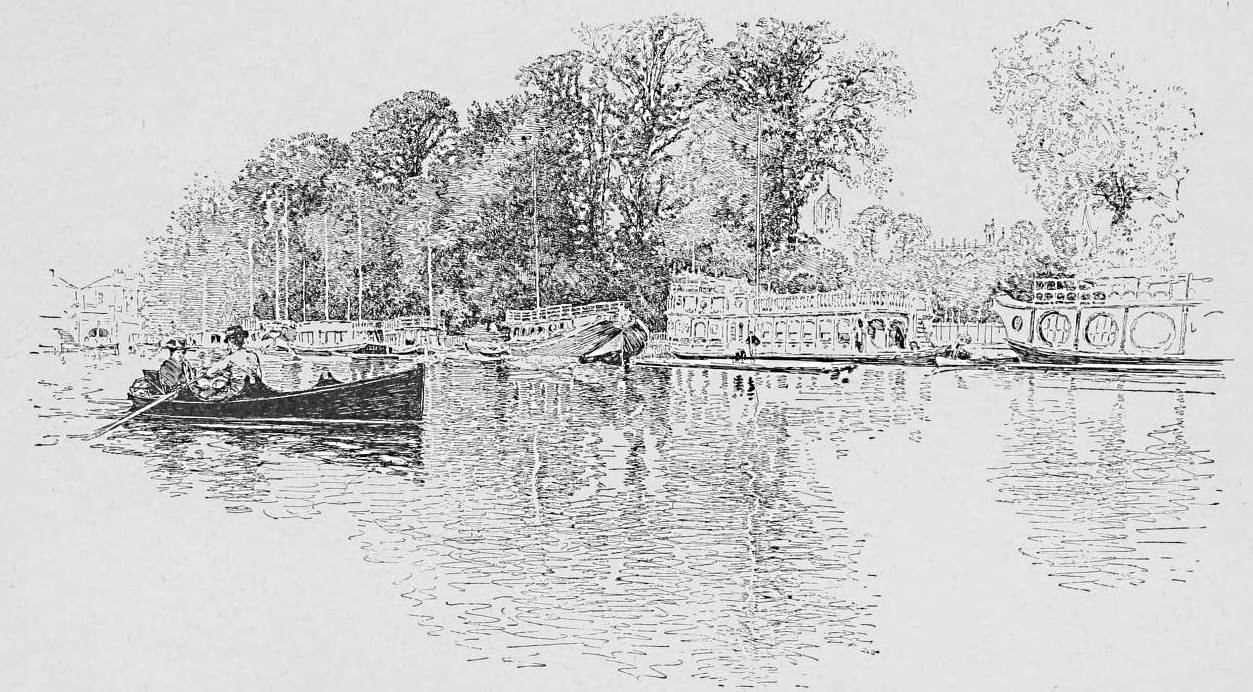
The college barges on the shore opposite from the pathway
would strike an Eastern traveller as bearing some resemblance to Chinese junks;
but they are vessels of great impotance, and some of them have even figured in the Lord Mayors' shows.
The University Barge was designed by a local architect, Mr Bruton,
and the Christ Church and Exeter have moorings at each end of it.
The interiors of these barges are beautifully fitted up with reading-rooms and dressing-rooms.
1850: A Punting Scene by the Christ Church Meadows from College Life by Edward Bradley

A PUNTING SCENE by the CHRIST CHURCH Meadows
" - Attolunt capita, et sublimi vertice nutant. Ir rum punt! - "
VIRG: AEN IX 682-3
from College Life by Edward Bradley, 1850 (British Museum)
Don't ask what the Aeneid quotation means - I think it is solely there
because of the latin word "Irrumpunt", (the English meaning "broke"? is probably not relevant).
Note that the nearest punt is being run (ie the punter goes to the front and then walks back down the punt).
This style is almost never seen today. The punt is moving to our left bows first
(which today in Oxford would be called Cambridge style)
1852: Inundation of Christ Church Meadows, Oxford, from London News 4th December 1852

Inundation of Christ Church Meadows,
from London News 4th December 1852
Christchurch Meadow in 'Oxford' by Frederick Douglas How -
Far smaller in extent [than Port Meadow], but even more famous, is the tree-girt space
called Christ Church Meadow, lying between that college and the river.
Port Meadow may be said to be a wide bright outskirt of the natural robe
of Oxford: Christ Church Meadow, with its Broad Walk and its mighty
trees, is like a fold about her feet deep-trimmed and bordered with a
silver braid.
It is here that on Show Sunday, in Commemoration Week,
in June, those who hold high places in the University, with favoured
guests, and some few undergraduates, pace up and down, or used to pace
in days gone by; for it belongs to a more modern pen to say whether the
old custom still obtains, or whether it has passed away with other
things of ceremony ...

1873: Adverts in Henry Taunts New Thames Map - see Brasenose Barge
 Lantern Slide (1883-1908) - Oxford University Barges
Pictures by W.C.Hughes. Thanks to Pat Furley, research by Dr Wilson.
1891: Elizabeth & Joseph Pennell, "The Stream of Pleasure" -
It was pouring in torrents on the morning of the 1st of August, when we drove from "The Mitre" down to Salter's boathouse at the appointed hour. Our boat which was brand new and had not yet been launched, was not ready, and Salter's men seemed surprised to see us, This showed that the weather was even worse than we thought it and the outlook more hopeless. And yet, during the couple of hours we waited on the rain soaked raft, two or three other pleasure parties started out in open boats. The girls in the stern, wrapped in mackintoshes and huddled under umbrellas, and the men at the skulls, their Soaked flannels clinging to them, look so miserably wet that we felt for the first time how very superior our boat was. It was only a pair-oared skiff, shorter and broader than those generally seen on the Thames - "a family boat", an old river man called it with contempt; but then it had a green waterproof canvas cover which stretched over three iron and hoops and converted it for all practical purposes into a small, a very small, houseboat. By a complicated arrangement of strings that canvas could be so rolled up and fastened on top as - theoretically - not to interfere with our view of the river banks on bright days; or it could be let down to cover the entire boat from stern to bow - an umbrella by day, a hotel by night. Under it we could camp out without the bother of pitching a tent. We had already talked a great deal about the beautiful nights upon the river, when we should go to bed with the swans and rise up with the larks, and cook our breakfast under the willows, and washh our dishes and ourselves in quiet clear pools. What if river inns were as extortionate and crowded as they are said to be? We should have our own hotel with us wherever we went. In the midst of a weak and damp hurrah from one ancient boatman, and under a heavy baptism, not of champagne, but of rain, the "Rover" was at last pushed off her trstles and with one vigorous shove sent clean across the Thames to the raft where we stood under umbrellas, while Salter's men at once began to load her with kitchen and bedroom furniture. They provided us with an ingenious stove with kettles and frying pans fitting into each other like the pieces of a Chinese puzzle, the lantern, cups and saucers and plates, knives and forks and spoons, a can of alcohol, and, for crowning comfort, a mattress large enough for a double bedstead. It fills the boat from stern to bow, covering the seats, burying the sculls and boat hooks, bulging out through and over the rowlocks. It was clear if it went we must stay, and so we said, as if we rather liked the prospect of roughing it, that we could manage just as well and be just as comfortable if we slept on our rugs; for we carried all the Roman blankets and steamer rugs we possessed, together with a lot of less decorative blankets borrowed from our landlady in London, and the bundle they made to took up the place of two people in the boat. The locker was stored with our supply of sardines, jam, chocolate, tea, sugar, biscuits, towels, and tea cloths. Our bags were stowed away with the kitchen things. And then at last we crawled into the long green tunnel. Some one gave us a push. If salter was looking on from his window, he probably regretted his bargain and wished he had given us the shabbiest old up river tub in his collection. For in midstream the aggressively new Rover came to a dead stop, and swung around with the wind. I had never steered, Joseph had scarcely ever rowed a boat, and between us we had not the least idea how to manage it. We thought there was a laugh on shore, but we could not see the men who were watching us, as the canvas shut us in on all sides, leaving but small loopholes at bow and stern; we were sure we heard someone saying: "If you are going down the Thames in that boat, you'd better use the right sculls!" Luckily the river was almost deserted;
Sketch by Joseph Pennell, 1891
1906: Christchurch Meadows from the River, Oxford by Andrew Lang -

1906, Christchurch Meadows, Andrew Lang
1908: Isis Boatclub Oilette -

1908, Isis Boatclub Oilette
1922: Punts below Folly Bridge, Francis Frith -

1934: College Barges -

College Barges, 1934
1822: 'Christchurch Walk' in 'The University and City of Oxford'
View from Christchurch Walk -

By Christchurch Walk, 1822
On the right hand end of the bridge I think you can see that it was lockable -
1880: Church, Summer Days-
the towpath was blocked by a lofty door, defended with formidable rails ... in the interests of the watermen, who made a rich harvest by ferrying passengers across from Christ Church Meadows.
1937: "The Thames and its Story" -
... the college barges ... are an interesting study in development.
The first of them were old procession barges of the London City Companies.
One of them, the Oriel barge, still remains, with its delicate form, and long sharp prow,
in which the rowers sat. The bronze figures by the door of the saloon are untouched,
the oval windows, the tarnished gilding within.
But the spirit of utility rebelled and the model changed.
The long prow was chopped off close, the semblance of the high stern went,
and there was left merely a square floating dressing-room with railings round its roof,
and seats for the spectators of the races.
Then the sense of beauty mutinied, perhaps alleging the use of the toy for picnic excursions,
and the prow and stern were restored.
The University barge is a monument of the Gothic revival.
Several architects have tried their hand in designs for these craft,
and new ones are from time to time constructed.
It is the oddest little street, this row of motley Noah's Arks;
and when the high poles shake out their amazing flags,
and the men come down in fearless college colours,
and a vaste and diverse millinery decks every foot of standing the roofs can give,
there would seem to be some touch of an Arabian Night about a very English day,
were it not that the vigorous people wear many more colours than Arabia would allow.
Lament for the University College Barge, sold in 1965 -
And so she had to go
Was sadly moved away
Instead the water flow
The gap remains today
Toll for the Barge!
Stout Bossom has now gone
His last load poled across
His ferrying done
The dripping landing stage
Where Univ boats made fast
the roof where every age
Has watched Eights racing past
The cheerful cabin's glow
The pictures on each wall
The oars of famous crews
Sweet cakes and teas for all
A floating common room
Set in a silver stream
This seat of Isis, whom
all hold in high esteem.
All this is now a dream
Our Barge's days are o'er
Proud prow and painted beam
Shall ride the Thames no more.
This whole stretch shouts to me that its level has been changed.
As D S Mackoll wrote in The Royal River in 1885:
the river has banks instead of brims
... another question, that of floods, presses as much as ever.
Quite recently the engineer to the Thames Commission brought out a scheme for doing away with Iffley Lock and Weir,
and dredging a deep and narrow channel between Iffley and Folly Bridge. The Vice-Chancellor and the Dean of Christchurch,
both by virtue of office Commissioners, were in favour of this scheme with a view to Oxford health;
but it has been proved to the satisfaction of the Thames Conservancy Board, whose officers have examined the place,
that so sweeping a change is not needed.
The effect of the change would be to give the river banks instead of brims, and it has been argued that it would kill the elms of Christ Church
and the fritillaries in the water meadows about Iffley.
Most serious of all would be the loss of Iffley Mill.
We may hope that Oxford health need not be bought so dearly.
Fred Thacker, The Thames Highway, Volume II Locks and Weirs, page 133 says -
Towards the end of this year [1885] a very determined local effort was made towards abolishing the [Iffley] lock, mills and weirs. The level of the River up to Folly Bridge was to be lowered 2ft 6in, but the bed was to be dredged so that there should be a uniform depth of about five feet. Several local petitions, however, perhaps decided the Conservators against any interference with the station.
So, as yet, I cannot pin down any reference to actually reducing the levels. But my evidence that it was done is clear to me.
The height of the wharf at the Head of the River; the height of the walls by Magdalen Bridge; the banks all the way down to Iffley Lock
(where the river would be expected to be close to bank level) all show it to be so.
Any evidence of the change to weir or lock would have been removed by the extensive rebuilding of the Iffley Lock area in the 1920s.
And I do know that extensive dredging was done (which of course would have been a necessary move after levels were reduced)
witness the following photo, they dredged the hard way in those days!
If you look carefully I think you can see that the level has been recently reduced. -

Dredging at Oxford, 1885, Henry W Taunt
© Oxfordshire County Council Photographic Archive; HT219
Bottom Ice in the Freshwater Thames!
One of the great scientific facts of my childhood was the understanding that
whilst most liquids become denser as they get colder this only applies to water down to a point,
and that point is at about 4°c.
Water is at its densest at this temperature and then as it cools further it actually gets less dense.
This strange quirk of nature is probably responsible for the survival of life on earth
and certainly for life on land.
Together with the fact that ice is less dense than water and therefore floats - it means that even relatively
small bodies of water never freeze through to the bottom - and therefore life could survive.
The convection currents caused by water cooling at the surface, becoming denser and falling, cease at
4°c and even reverse (colder water being forced to the surface where it freezes and insulates the rest).
I write this because I have recently discovered the following:
It is in "Oxfordshire of One Hundred Years Ago" by Eleanor Chance.
W E Sherwood writes -
There is another thing which I suspect the Conservancy, by their dredging, may have stopped,
but I am not certain, as it is so long since we have had a severe winter,
and that is the formation of 'ground ice', ice that is that forms on the bottom of the river.
When I spoke to my science master about it he talked about the maximum density of water,
and told me that the thing was impossible, but I took him down to the river,
and showed him, opposite the barges [ie the College Barges along the RIGHT bank at Christchurch Meadow],
the bottom all covered in ice.
I think he was annoyed, but at the river for behaving so unaccountably - indecently even, he seemed to think -
and not at me. He was so far right that in a lake or in a river of uniform depth the ice cannot so form,
but in the Thames in those days there were deep reaches followed by banks of gravel
over which the water was shallow.
In times of frost the heavier warmer [ie 4°c] water sank and remained in the deep parts,
and what flowed on was the lighter water at or close to freezing point,
and when the crystals formed in this they attached themselves, as forming crystals will,
to any solid they could find; in this case to the gravel at the bottom.
This ice rose from time to time in spongy masses, bringing with it some of the gravel,
and floated on until it reached the lock. Here it packed, and if the frost continued,
formed a thick mass of rough ice which, as more came down extended further and further up stream;
and it was on this ice, far more than surface ice, that on three occasions I remember a coach and four
was driven from Folly Bridge to Iffley.

A Coach and four on the Frozen Isis, 1890?
Owing to the deepening of the river I doubt that this will ever again be possible, though at Binsey, the other point near Oxford where I have seen ground ice form, it may well do so.
[ I suspect there is another physical factor at work here. I guess there comes a point where almost
freezing water does not freeze because it is moving. The gravel would offer many tiny 'shelters' between
the stones in which the water would be relatively still and perhaps that is where the crystallisation started?
One would be interested to hear from a real physicist about this ... ]
1818: Walks in Oxford: By W. M. Wade 1818 -
A rather curious circumstance in the natural history of this river is its always freezing first at the bottom, whence the masses of ice as they are formed rise to the top.
1791: Samuel Ireland in his Picturesque Views on the Thames writes, of Buscot -
REMARKING that all the watermen, and
persons concerned in the navigation, have an idea, and boldly assert, that the river,
in this vicinity, freezes first at the bottom;
and that they frequently find icicles and congelations adhering to the keels and bottoms
of their boats, when there is no appearance
of ice on the surface;
and feeling myself
not satisfied with this trite and vulgar opinion,
I am induced to refer for a more philosophical and convincing proof of the assertion;
when in Dr. Plott I find the following
observation:
"That the water-men frequently meet the ice-meers, or cakes of ice, in their rise, and sometimes
in the under-side including stones and gravel, brought with them ab imo [ latin - "from the bottom"];"
and he observes,
"it is consonant to reason, for that congelations come from the conflux of salts, before dispersed at large,
is as plain as the vulgar experiment of freezing a pot by the fire ;
and that induration and weight come also from thence, sufficiently appears from the great quantities of them that are always found
in stones, bones, testaceous, and all other weighty bodies."
He likewise seems to credit the assertion of a person who once
saw a hatchet casually fall overboard into the
river, near Wallingford, which was afterwards
brought up and found in one of these
ice-meers.
As my author sometimes deals in the marvellous, I shall suspend any comment
on these observations.
1813: The Beauties of England and Wales -
The congelation of the river Thames uniformly commences in the lowest places.
The mass then formed rises (on a rude calculation) to about the middle of the water, where it presents,
as in the streams of Germany, a resemblance to the partial consolidation of nuclei, or small hail.
A second mass then forms at the bottom ; the mass, centrally situated, rises to the surface ;
and the new bottom, or ground ice, takes its place, and gradually (if permitted by a continued obstruction of sun-beams) mounts to
the superior fabric, with which it speedily assimilates.
Dr. Plot accounts for this circumstance by supposing that the water of the Thames is more abundantly impregnated with salt than that of other English rivers ;
and that, as salt naturally sinks to the bottom, and, as naturally, inclines to a principle of congelation,
the formation of ice consequently takes place first at the greatest depth.