Aerial view of Folly Bridge
Street view of Folly Bridge from Upstream
Street view of Folly Bridge from punt rafts
Street view of Folly Bridge single southern arch, the site of Folly Lock
A River Runs through it. People, Places, Things - Stories from Oxford.
1880: The Thames: from Oxford to its Source
by Paul Blake, being six weekly installments from The Boys Own Paper, April 21st - ,1888
[ All a bit "I say you fellows ..." but nevertheless an interesting account of rowing (and towing)
from Oxford to Cricklade in 1888 - including how to manage a paddle and rymer weir. ]
1909: Folly Bridge in THE STRIPLING THAMES by Fred Thacker.
Rivers were made for wise men to contemplate;
and fools to pass by without consideration.
Fred's book is the great book of the Thames Valley above Oxford. He is of interest to the boater who stays afloat
for the various perceptive comments about the river - but he also takes a wide sweep up the valley
visiting most of the tiny hamlets and villages and poking into their churches and researching their history.
The entire text is online and links from appropriate points are shown from here on up river.
To remind us of how much the river has changed he says of going above Folly Bridge:
However often one may turn upstream under Folly Bridge, it is always with a sense of entering upon an
undiscovered land that for many centuries has lain quite undisturbed.
Once beyond the city boundaries there begins to stir within the heart the gladness of escape from
civilisation and modernness, of the dawn of a world still to be explored however often visited.
To the ordinary voyager from London, intent upon "doing the River" in the fewest possible days,
Salters' raft is the ultimate limit and source of the Thames.
He learns, if he learns anything, of mere slums above, of gasworks and railway bridges and easily concludes that Nuneham and Iffley
are the last word the River has for him, and that beyond this raft he need not ascend.
1910: Folly Bridge in Thames Valley Villages by Charles G Harper
Folly Bridge alias Grand Pont, or South Bridge, or Friar's Bridge, or Hinksey Bridge.
Anglo-Saxon Oxford, © Anglo-Saxon Oxfordshire, John Blair, 1994, Sutton Publishing Ltd, pp.87-88 -
A hidden but powerful influence on the Oxford crossing is the presence of two Roman roads,
cutting obliquely across the Thames-Cherwell confluence and converging on Frilford to the south-west.
The more northerly served an extensive Roman settlement in the North Oxford area;
the other left the Dorchester-Alchester road near Headington Quarry,
crossed the Thames channels near modern Donnington Bridge and at Redbridge, and continued over Boars Hill.
The Redbridge section partly survives as an ancient causeway;
its small, spaced-out flood-arches resemble those of the Norman Grandpont,
but they could just possibly be Roman.
Somewhere near this point, the late Anglo-Saxon bounds of Kennington and Hinksey mention a 'stone ford' (stanford).

Anglo-Saxon Oxford with the many river streams in blue.
So which was the ford which gave Oxford its name?
I know of three ancient fords:
a) Here, somewhere near Folly Bridge
b) The Stanford (Stone ford) where the Port Way crossed near Donnington Road Bridge
c) Binsey Ford on Port meadow just above Medley Footbridge
[ In ancient texts beware that "bridge" may mean any crossing, ford or ferry,
and does not necessarily refer to a structured bridge in the modern sense.
(See Lambeth Bridge) ]
Much of what follows comes from 1773: THE ANTIENT and PRESENT STATE of THE CITY of OXFORD
Of [the bridge's] Foundation, it is so ancient that no Record can resolve its precise beginning.
865- In the reign of King Etheldred -
Then Almary Earl of Cornwall gave to the Abbey of Eynsham, duo prata juxta Portam Australem Oxon
1085: Robert Doyly, who had great Possessions in these Parts,
erected or re-edified the Magnus Pons or Pons Oxenford of Stone
1091: Columbanus, Abbot of Eynsham, gave the bridge to Neale Doily, with other Possessions adjoining.
1104: One of the Registers of Abingdon tells us, that -
Ermenold, a Burgess of Oxon, held of Faritius, Abbot of the same, Wycam (the Wyke) Juxta Pontem Oxenford
An Hermit here, as at Petty Pont [Magdalene Bridge], was used to live in an Hermitage on this Bridge,
called St. Nicholas's Chapel, opposite to Briggewyth's Place (built by the Monks of Abingdon,
and afterwards by them let out to the Burgesses of Oxon for the Rent of 8d. per Annum)
in order to receive Toll or the Customs.
1342: T. Legh, Town-Clerk, left a Messuage in Grope-Lane, Anno 1342, for repairing the bridge
1349: R. Fleetwood left a property in St. Edward's Lane, called Bcokenfeild, to be sold, to pay for repairs
1369: Grauntpount had a grant made to it for rebuilding.
The structure was "in so dangerous a state as to be well nigh
impassable".
1377: H.E. Salter, ed. Munimenta Civitatis Oxonie -
Indenture by which William le Northerne mayor of Oxford and the entire community of that
town lease to John Leper a plot of land next to Cowmead in the county of Berkshire,
called the Bridgewright's Place, opposite the chapel of St. Nicholas, for the term of
his life for an annual rent of 12d. [payable] quarterly.
For the term of his life,
John is to maintain, repair and support the bridge of Grandpont both on the inner
and the outer sides of the New Gate, using the alms given and bestowed for that
gate and what he receives for himself, and is to preserve the plot and the buildings
presently standing or to be constructed there in the future without any deterioration
or damage.
Should it happen that the rent be in arrears for a full year,
or John be responsible for deterioration or damage to the land or the buildings,
or fail to maintain the bridge, John acknowledges that the community and its successors
will be fully within their rights to re-enter and repossess the land, buildings,
and appurtenances, etc.
Given at Oxford on 20 January 1377.
1530: J. Claymond repaired it quite through at his own Charge
1600? Friar Bacon's study, Folly Bridge and the northern end of the Grandpont causeway shown on a Brasenose College Estate Map of 1569-1610.

Friar Bacon's study, Folly Bridge and the northern end of the Grandpont causeway
shown on a Brasenose College Estate Map of 1569-1610.
1609: Tho. Fawkner bequeathed 6s. 1d. per Annum to repair this Bridge
from Friar Bacon's Study to Hinxey Steps, to be paid by the Chamberlains of Oxon yearly on Good-Friday
in St. Aldate's Church, to be received by the Church-Wardens of that Parish
1578 & 1585: Dr. Lloyd, Principal of Jesus College, disbursed several Sums of Money towards enlarging it
with Timber within and without Friar Bacon's Study, so far as the
Liberties went , as also for railing it on both Sides
1662: Baskervile -
Hinksey Bridge contains 18 arches from ye
footpath wch com from Hincksey ascending by stone steps into ye horse Casway
viz from yt place to ye South side of ffryer Bacon's Study are 20 Arches, North
of ffryer Bacon's Study are 3 Arches &
over Gramspond stream wch makes 4 Arches in that side.
The whole number amounting to 42 Arches.
The bridge is about 100 yards over beginning at ye south side of ye Arch
south of ye study & so passing through ye Gate way as far as ye Quine of ye
wall wch turns into ye Wharfyard. The
whole length of these Bridges and Causway may be a mile & ½.
[ Baskervile always counts the approaching
Causeway to a bridge on either side. In
his time this would have been much more evident as the banks were less well
defined and frequently there would have been marshy areas either side of the
originally shallow areas where fords became established prior to the building
of the bridges. ]
1690?: Celia Fiennes -
... crossed ye River Thames on a bridge att ye end of ye town and rode along by ye thames side a good way, wch was full of Barges and Lighters.
1714: Oxford letters in Portland MSS -
June 26:
J.D. will be in town as soon as there is water enough in the river to carry up the
barge; at present there is not, the channel may be passed without wetting your shoes in
many places between this and Abingdon.
July 6:
No rain
yet with us, nor can we tell when our river will be navigable again.
Aug 19:
The boat which brings your books is expected
here tomorrow. You may perceive how
scarce water is with us.
1720: Camden -
To Oxford Bridge the Thames will bear a Barge of 90 tun.
Photograph of Engraving of Folly Bridge demolished in 1827, Henry Taunt, 1907 -

Photograph of Engraving of Folly Bridge demolished in 1827,
Henry Taunt, 1907
© Oxfordshire County Council Photographic Archive; HT10320
1779: Bacon's Study sold for £13 and demolished. See the next section Bacon's Folly. 1791: Samuel Ireland -
On quitting Oxford, we passed the ancient
bridge, formerly called Grand Pont, or South Bridge, but which is now better
known by the appellation of Folly Bridge.
It is said, by some, to have derived this name
from the circumstance of Friar Bacon having
chosen this spot, being on the side of a
public road, and on the banks of a navigable
river, for the situation of his study a situation, of all others, it should seem, the least
adapted to the purposes of retirement and
cultivation of the mind.
Another, and more
probable, account is, that it was so called
from some original defect in the arches,
which were obliged to be supported by additional means.
1791: Mylne - the weir at the bridge is in very bad order.
1793: (from Fred Thacker, 1920) -
... the obstruction in passing through Folly bridge is the greatest throughout the whole river; the Bargemen all agree on this point. The largest arch is only 14 feet wide; and what with the wharf below and the Meadow above it is not possible to pass a long barge without twisting it and much damage. A pound lock must be made a little to the west.
1797: Repairs to the Arch at Folly Bridge. It is recorded that the two largest
openings in the old bridge did not lie rectangularly with the roadway,
but at an angle (it is alleged) of about 45°, to accommodate the
direction of the early stream.
1803: the navigable arch was decayed and impassable. It was repaired.
1810: Arguments between Oxfordshire and Berkshire as to which should pay for rebuilding.
The work was begun, the water was pumped out of the river, and the disturbing discovery was made that the
foundations and interior of the bridge were ruinous, after the wear and
tear of seven and a quarter centuries.
1815: June 28th, Royal Assent to an Act to rebuild Folly bridge and to remove the
Tackle and Works under the present bridge for the purposes of the river
navigation to some more convenient part above and within 200 yards of the
bridge.
Fred Thacker adds:
The meadow island, which as I have said, lay immediately above the bridge might be dug away to straiten the channel; the bargeway having, up to this time, run round the north side of this ait. This old channel was filled up after 1825 and the present (1920) channel or basin opened for traffic.
Fred's comment about the island is explained by the next map dated 1815 in the University College archives. The island referred to is marked "2."

Folly Bridge, 1815. UC:E2/10/1M/1
Note the proposed new channel pencilled in (just touching the figure "2.")
which I think starts more or less where the modern channel starts, but is much more curved
with a less abrupt turn where the modern piles are.
Also see the pencilled tentative railway line (dated 1845 in pencil).
It was near the line of Marlborough Road and would have crossed the river more or less where
the footbridge is. Fortunately it did not happen!
1821: Pound Lock built on the LEFT bank
behind Salter's rafts. It is said
that only its lower end had ordinary lock gates;
its upper end was fitted with
sluices; and in high water times
it was left open.
1822: Folly Bridge, the old bridge, demolished in 1827 -

The Boathouse, old Folly Bridge, 1822
The old bridge (pre 1826) in 'A topographical and historical description of the University and city of Oxford' 1829 -

Folly Bridge, pre 1826
GRAND PONT, USUALLY CALLED FOLLY BRIDGE.
The old bridge, the [print above] has been recently taken down,
and replaced by an elegant modern bridge of four arches.
This, and other alterations now carrying into effect, will greatly improve the southern entrance to Oxford.
The old bridge was narrow, with angular recesses over the piers;
it originally consisted of four pointed arches, but, from the constant wear by the rapidity of the stream,
and from its great antiquity, the repairs, at various periods, had so altered their appearance and size,
that their original shape could with difficulty be discerned.
Grand Pont was so ancient that no record is left of its first erection.
The abbots of Abingdon, who claimed a right to the toll of this bridge, which is situated in Berkshire,
in their register called it the Old Bridge, soon after the Norman conquest.
Before that period it was built partly with timber; but Robert de Oili, who built Oxford Castle,
and was Governor of Oxford during the reign of the Conqueror, rebuilt this bridge entirely with stone, in 1085;
and so solid was the erection, that it was taken down with great difficulty in 1825.
The above quotation says 'four arches'; Fred below says 'three' - and indeed there are only three - unless you count the
arch the other side of the island over what was the lock cut
1826: Fred Thacker, The Stripling Thames (1909) -
The present three arched bridge was completed about 1826. It lies due north and south, and is plain and somewhat smug, and probably not as picturesque as its predecessor erected about 1085 ...
1827: Folly Bridge Works completed.
1830: Folly Bridge and Lock in OXFORD ROWING, Sherwood, 1900 -

Folly Bridge and Lock in OXFORD ROWING, Sherwood, 1900.
Notice Folly Lock on the left (removed in 1884).
1832: Fearnside - the weir above the bridge
is broad and well constructed.
1837: Folly Bridge in Memorials of Oxford by James Ingram -
Folly bridge, so called from the tower or folly which stood on it,
was formerly called Southbridge. The first erection of a bridge on
this spot is beyond all authentic record ; but there certainly appears
to have been a bridge here in the Saxon times, according to the
opinion of our best antiquaries.
Various particulars respecting the
old bridge will be found in Wood ap. Peshall, p. 257. 259.
...
The present substantial
bridge was built in 1825-27, under an act of parliament passed in
1815. The architect was Ebenezer Perry. The expense was defrayed
by loans to be repaid by the produce of the toll gate.
The water-works and the wharfs adjacent to this bridge, erected in
accordance with the recent alterations of widening the approach to it,
are in a style worthy of the entrance to such a city as Oxford.
We have many incidental proofs that the river was navigated so high as
Oxford, if not higher, from a very early period. A kind of toll, payable
to the monks of Abingdon, in the time of Edward the Confessor,
is mentioned by Wood ap. Peshall, p. 259, which sufficiently indicates
the fact ; and that a considerable inland trade was carried on by means
of the navigation of the river.

Folly Bridge, 1837
1837: The Quarterly Review -
... for a stone bridge may be formed into a lock or stoppage of the river by means of transverse timbers
from pier to pier, sustaining a series of boards called paddles, opposed to the strength of the current,
as was heretofore seen on the same river Thames, where it passes the city of Oxford at Friar Bacon's Bridge,
on the road to Abingdon.
Such paddles are there in use to deepen the irregular river channels above that bridge;
and the boat or collected boats, of very considerable tonnage, thus find passage upwards or downwards,
a single arch being occasionally cleared of its paddles, to afford free passage through the bridge.
1848: In Pleasant Spots around Oxford, by Alfred Rimmer -
... Folly Bridge which is comparatively modern, being built in the year 1826, in place of an ancient one that was taken down. This old bridge was a very picturesque structure, consisting of three arches and a small culvert. A very accurate model of it is preserved in the Ashmolean Museum, and the remains of the old Oxford waterworks are shown in it at one end.
1859: The Thames, Mr & Mrs Hall
Leaving to the left [going downstream ie on the right bank] the rugged island, once the site of Osney, and
now covered with houses of a low grade, with rough gardens, inclosed
by dilapidated walls or broken palisades, and to the right[] the fertile
meadows around which winds the ancient bed of the river, we arrive at
Folly Bridge, *
* The bridge at which the several branches of the Thames unite was anciently
called Grand Pont and South Bridge; it is now named "Folly Bridge"
but must previously pass through a lock [ Folly Lock, at the bridge ], the river here
having a fall of about three feet.
...
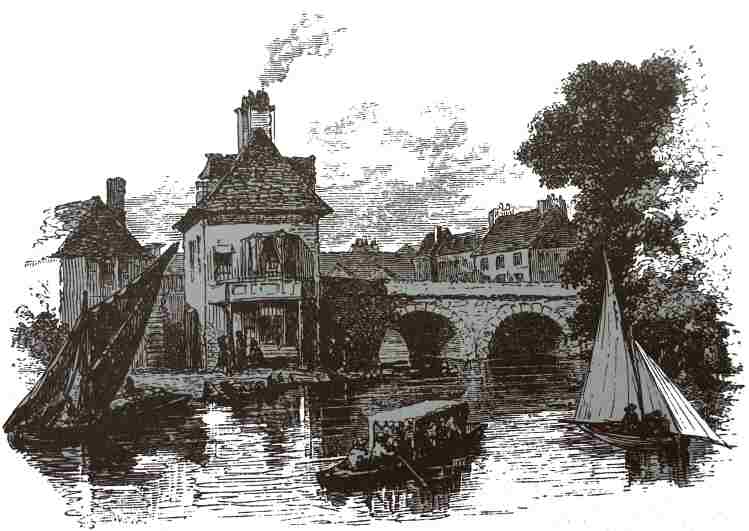
FOLLY BRIDGE
We must resume our course; and, making our way again to Folly Bridge, bid adieu to the fair city, quoting, as we enter our boat, the quaint and homely couplet of the old poet:-
He that hath Oxford seen, for beauty, grace,
And healthinesse ne'er saw a better place.
Folly Bridge was anciently called Grand Pont. Its modern name (modern, although dating back 200 years) is derived from the following circumstance. The tower, which stood on the bridge, and had been so long known as "Friar Bacon's Study", being much dilapidated, the city leased it to a citizen named "Welcome", who repaired the lower part, and added to it a story[sic], which appears in our engraving. This was called by the neighbours "Welcome's Folly"; and thus the bridge acquired its new title of "Folly Bridge." The present bridge was built in 1825-7: the architect was Ebenezer Perry. The first erection of a bridge on this spot is "beyond all authentic record"; but it is the opinion of our best antiquaries that here a bridge existed so early as the Saxon times. We are below Folly Bridge, having passed through the lock, which, as we have intimated, terminates the right branch of the river: there is a fall here of about three feet. The bridge is seen in the annexed view. A tavern, situate on a sort of quay, and a block of warehouses, sufficiently mark the locality, but the latter unfortunately interrupts the passage into the street from the beautiful grounds of Christ Church. Christ Church Meadow, with its embowered "walks", has been famous for ages; it is the public promenade; and necessarily here, or at the quay alluded to, boats are always numerous, for this is almost the only place in the vicinity in which there are conveniences for boating.
1861: Ravenstein - a fall at the lock of about three feet.
1866: from Sherwood's Oxford Rowing -
1866. This year the University presented a first-class lifeboat
to the Royal Lifeboat Institution. It was brought down
to the river on a cart, and manned by the University Eight and
Messrs. J. J. Hornby and W. F. Short, Old Blues.
Archdeacon Clarke read a few Collects, and then Mrs. Lightfoot, wife of
the Vice-Chancellor, dashed a bottle of wine against the bows
and named it the Isis. A rope was then cut, and the boat
with its crew dropped five feet into the water, and was rowed
past the barges.

The Launch of the Lifeboat Isis
After this it was taken to the wharf near Folly Bridge, and, the crew having left it, was upset to show its self-righting powers. It is now stationed at Hayle, in Cornwall.
Over the next twenty one years that boat saved 51 lives. It is said that ten thousand people turned out to see it launched -

Folly Bridge lifeboat launch, 1866
1870s: Photo of lock, on left, Salter's premises, and far end of Folly Bridge on right.

Folly lock, Salters and Folly Bridge 1870s.
The lock was removed in 1884
1872: Taunt - the lock was open in high water time, with a summer fall of 1½ to 2 feet
1878: If you wonder how in 1866 the lifeboat launching could have involved a barge
for spectators apparently completely blocking the bridge - then here is the answer.
This part of the bridge was only over a weir stream.
The navigation channel was through FOLLY LOCK. See this OS map of 1878:

1878 Ordnance Survey Map showing Folly Lock and weir
Salter's Steamers still occupy the space as if there is a folk memory of when this was not actually the navigation channel!
1884: Lock gates completely removed and passage left open

Folly Bridge, c1910 postcard.
1905: Salters' Yard (now the Head of the River) with the paddle steamer Endeavour which was built for the Baptist Missionary Society. She was taken apart and shipped to the Belgian Congo. Salters contributed to the Society's costs by organising fund-raising trips on the river. In the Salter's History is a picture of this same boat in use on the Congo.

Paddle Steamer Endeavour at Salters Yard, Folly Bridge
 View from Folly Bridge lantern slide 1883-1906, W.C.Hughes, research by Dr Wilson, courtesy of Pat Furley
1906: G.E. Mitton -
To see the bridge properly, however, it is necessary to go down to the towpath and look back at it, when its quaint, foreign appearance can be better estimated. It stands across an island on which is the renowned Salter's boathouse, and its solidity and the tall houses near it which throw black shadows in the yellow sunlight make it look not unlike a corner in Venice.
1906: Folly Bridge in Oxford by Andrew Lang -

Folly Bridge, 1906.
1907: Folly Bridge -

Folly Bridge, 1907.
1929: A Thames Survey -
Mr. Thacker in his book "The Stripling Thames" has described the first recorded bridge at this crossing
built by Robert d'Oilli about 1085, then called Grand Pont and South Bridge.
The title "Folly" was not used until the seventeenth century, and had its origin in a building known
as Friar Bacon's Study, which stood astride the northern bridge-head.
This building is referred to in Pepys' Diary, June 9th, 1668
It was not demolished until 1779.
The present bridge was in course of construction from 1824 to 1827, at which time the weirs
were removed from the vicinity of the arches and the present channel opened for river traffic.
There are three main elliptical arches of stone.
The view from Folly Bridge downstream along the line of college barges is too well known
to require description here, nor need we emphasize the necessity for the greatest of care
in the design of any new buildings which flank the approach from the bridge to Carfax.
The view of Christ Church from St Aldate's has been safeguarded and improved by the recent clearance,
and we feel that the future destiny of Folly Bridge and its approaches, also the Cherwell bridges,
can be safely left in the care of the Oxford Preservation Trust, who have done so much to preserve
the amenities of the Thames Valley as far as it comes within the scope of their activities.
1994: Mollie Harris in her book named after Fred Thacker's Book 'The Stripling Thames' writes -
Shaded by a giant Ash tree,
This infant stream
Meanders through those early villages -
Ewen, Coates, Kemble and Summerford Keynes.
This bubbling stream, soon to gather strength
Before reaching Cricklade, Castle Eaton and Kempsford
Then on to Lechlade and St John's Lock -
Where 'Old Father Thames', reigns over the widening water.
Tumbling on to Radcot Bridge,
Where many a battle was won and lost.
Lovely names and lonely spots, like
Tadpole, Rushy Lock, Chimney and Shifford,
Where King Alfred held his first parliament.
Old Newbridge, Northmoor and Bablockhythe,
With memories of 'The Scholar Gypsy'.
Pinkhill, Swinford, Eynsham, and skirting Wytham Woods -
Under a canopy of oak and beech.
Then on to King's Lock, an easy reach, and on to Godstow,
Where fair Rosamond won the heart of a King.
Next to lonely Binsey Church and Saint Frideswide's well -
And Port Meadow where cattle are grazing, nearby to Tumbling bay.
Too soon to Osney, where once a famous abbey stood;
Then on to Folly Bridge, where the infant Thames becomes of age.
And where strong undergrads become 'Head of the River'.
2005: Folly Bridge by Doug Myers -

Punt hirers at Folly Bridge -

Punts for hire below Folly Bridge
[ My punt is in the corner just by the Trill Stream outflow. ]

Punts for hire above Folly Bridge
Notice the delaminated warning on the bridge -
|
Thames Conservancy Pass between piles Above bridge |
|---|
Good advice - but they just don't
write notices like that anymore nowadays!
[ The broad and well constructed weir
of 1832 was redundant by 1884 when the lock was finally left open.
I do not know when it was removed - but this
notice obviously dates from then. The
piles would have been drawn from the main channel - but there must have been
concerns about whether the sides were cleared totally. ]
Map: Oxford Waterways

Thames/Isis & Oxford Canal & Cherwell & Seacourt Stream & Bullstake Stream & Hinksey Stream
Almost all of this is canoable.
The dark blue is puntable.
Powered boats can only use the Thames and the Oxford Canal.
1864: George Leslie, "Our River" writing in 1881, visited in 1864 -
I paid my first visit to Oxford, and I must
confess to feeling very disappointed with a town of which I had heard so
much; this feeling arose a good deal
from my having formed a preconceived idea of the river beauty of the
place. I had imagined the gardens of the
old Colleges with lawns sloping down to the water's edge, and all sorts of
picturesque bridges in places. Then
again the stone with which the Colleges are built annoyed me greatly by its dreadful
smoky colour, and rotten appearance; and when I noticed many Tudor
mouldings in better repair than work of the days of Queen Anne, of course
doubts about their genuine age at once asserted themselves - indeed the whole
place seemed to be perpetually having new patches put up all over it.
The only College that came up to my ideal was
Magdalen, with its tower and bridge and the little Cherwell wandering by;
the Quad, too, was
mossy and grey, and evidently really old.
But the poor Isis was very disappointing, looking so muddy and uninteresting;
Folly Bridge to me was little better than some of the bridges on the Paddington Canal.
The river certainly gets pretty enough a very
short distance from the town, but as for playing a part in the classic beauty
of this world-famed city, I can say little for it.
The humble Cam at the sister university is
highly ornamental, and there is nothing in Oxford
comparable to the backs of the Colleges and the bridges at Cambridge.
Some of the Colleges too, such as John's, which is built of good honest
red brick, and which stands by the water's edge, are far finer than anything at
Oxford. I have visited Oxford several times, and have very
considerably modified my opinions about its beauty, but I do not think I have
ever got over my first impressions.
1906: Henry Wellington Wack, In Thamesland -
I have enjoyed many visits to Oxford during the past eight years. None was more delightful
than the first, when the great English University city impressed me with what I have ever regarded
as the mysterious atmosphere of all great places of learning in the old world.
One senses this same air at the Sorbonne in France, at Bonn and Heidelburg in Germany, and,
to a degree, at Harvard University.
I am of those who regret the brevity of student days, their lack of true appreciation by the student,
the perfunctoriness of the work all of us have carried on during our term.
To come upon Oxford for the first time on a bright spring morning is to wish oneself an active,
eager senior again - still free of those indigestible responsibilities which lie in wait for
every significant youth as he leaves Convocation Hall with his head full of valueless knowledge
of the Greek and Roman makers of a world long dead, while his hands and mind are as untrained
for life's rude realities as the 'bus horse for a hurdle race. ...
Americans never pass Oxford by.
Their own country, while great, is still struggling with the crudities of newness.
To those who come in the spirit appropriate to a pilgrimage to English shrines,
Oxford makes a fine appeal to lofty sentiment.
Go the rounds of these ivied college buildings in the companionship of an old and enthusiastic alumnus;
listen to his musing and his homilies, follow his affection for his own alma mater,
and join him in that exaltation which I have observed as he indicates points of natural
and artificial beauty from Gothic facade to a turf six hundred years old,
and you will get some notion of the tenacious influence of Oxford University.
2017: Bridge repair -
Work on the bridge, which was built in 1820, can only take place during certain parts of the year because of bats which live underneath it
and move away twice a year.
They have been temporarily roosted at a site further down the city's stretch of the River Thames.
Work to repair the west side of the bridge is pencilled in for next spring [2018].
[In September 2017], work will start to put up a 30-tonne steel frame which will support the bridge during the maintenance.
As part of that work engineers will bore through the road surface to replace limestone bricks which have been damaged by water penetration.
At Folly Bridge you can hire a punt
(make sure you have permission to go through the locks
if heading for Godstow or Nuneham).
Punting (on this site)
Daily Info, Oxford - Punting (up to date prices etc)
Other links including punting
Alice in Wonderland! Once upon a time there was a strange mathematical fellow at Christ Church College by the name of Charles Luttridge Dodgson otherwise known as Lewis Carroll. He was thirty, unmarried and stuttered. He had a camera and was fascinated by young girls - including the young family of the College Dean, Henry Liddell. One of his daughters was Alice ...
Many a day we rowed together on that quiet stream the three little maidens and I and many a fairy tale had been extemporised for their benefit yet none of these many tales got written down: they lived and died, like summer midges, each in its own golden afternoon until there came a day when, as it chanced, one of my little listeners petitioned that the tale might be written down for her.
On the 4th July, 1862, Charles and a friend of his, Robinson Duckworth, hired a boat at Folly Bridge and invited Alice and her two sisters. Charles Dodgson wrote in his diary -
Duckworth and I made an expedition up the river
to Godstow with the three Liddells: we
had tea on the bank there, and did not reach Christ Church again till quarter
past eight, when we took them on to my rooms to see a collection of
micro-photographs, and restored them to the deanery just before nine.
On which occasion I told them the fairy-tale of
Alice's Adventures Under Ground, which I undertook to write
out for Alice ...
Robinson Duckworth also described this trip -
I was very closely associated with him in the production and publication of 'Alice in Wonderland'.
I rowed stroke and he rowed bow in the famous Long Vacation voyage to Godstow
when the three Miss Liddells were our passengers,
and the story was actually composed over my shoulder for the benefit of Alice Liddell,
who was acting as 'cox' of our gig.
I remember turning round and saying, "Dodgson, is this an extempore romance of yours?"
And he replied, "Yes, I'm inventing as we go along."
I also remember as we conducted the three children back to the Deanery, Alice said, as she bade us good-night,
"Oh, Mr Dodgson, I wish you would write out Alice's adventures for me."
He said, he should try, and he afterwards told me that he sat up nearly the whole night,
committing to an MS. book his recollections of the drolleries with which he had enlivened the afternoon.
He added illustrations of his own, and presented the volume, which used often to be seen
on the drawing-room table at the Deanery.
There were several trips. There is an account written many years
later by Alice Liddell which may refer to this trip, however she says "Down
the river - to the meadows", and since she was used to the river,
having steered boats up and down locks, and was herself later an undergraduate
at Oxford, I have chosen to believe her that that trip was downstream as
mentioned just above Iffley Lock. Medley
Flash weir was still in place at that time.
I find it difficult to believe that the exercise of getting up through
it, and shooting it on the return would not have fixed in her memory what was
up and what was down river!
Years later Charles Dodgson wrote about
the original telling of the Alice stories -
I distinctly remember - how, in a desperate attempt to strike out some new line of fairy-lore, I had sent my heroine straight down a rabbit-hole, to begin with, without the least idea what was to happen afterwards. Full many a year has slipped away, since that golden afternoon that gave thee birth, but I can call it up almost as clearly as if it were yesterday - the cloudless blue above, the watery mirror below, the boat drifting idly on its way, the tinkle of the drops that fell from the oars, as they waved so sleepily to and fro, and (the one bright gleam of life in all the slumberous scene) the three eager faces, hungry for news of fairy land.
[ Isn't it fascinating that the idea of "striking out some new
line of fairy-lore" should have continued in Oxford:
from Lewis Carroll's "Alice in Wonderland"
through C.S.Lewis' Narnia books;
to Professor Tolkien's "Lord of the Rings"?
And indeed if you look at the next section you will find a suggestion about how
Folly Bridge and the Lord of the Rings are connected. ]
Above the bridge there is a short section before the piles, and then the streams unite. On the RIGHT bank is Friars Wharf.