| Lock: | Telephone: | Postcode: | Map ref: | Lat/Lon: |
|---|---|---|---|---|
| St John's right bank |
+44 (0)1367252309 | GL7 3HA | SU 22216 99042 |
51.68971 -1.67994 |
| Upstream: | Downstream: | Length: | Width: | Fall: |
| Cricklade Bridge 18.88kms 11.73 miles |
Buscot Lock 1.85kms 1.15 miles |
33.60 (110'3'') |
4.52 (14'10'') |
0.85 (2'10'') |
| Upper sill: | Lower sill: | Facilities: | ||
| 1.32 (4'4'') |
1.32 (4'4'') |
Tap, Toilets, Chem disposal, Pump out, Refuse, Electric, Recycle | ||
St John's to Buscot, Environment Agency 'Out and About' Guide
This section in The Stripling Thames by Fred Thacker
1910: Thames Valley Villages by Charles G Harper

Fred Thacker’s Map, 1920.
1775: a weir is shown on Bowen’s map.
1790: St John's pound lock was built.
1792: the completion of the
new navigation works to link up with the Thames & Severn Canal.
1830: The first lock house
(on the left bank of the lock – between weir and lock) was built.
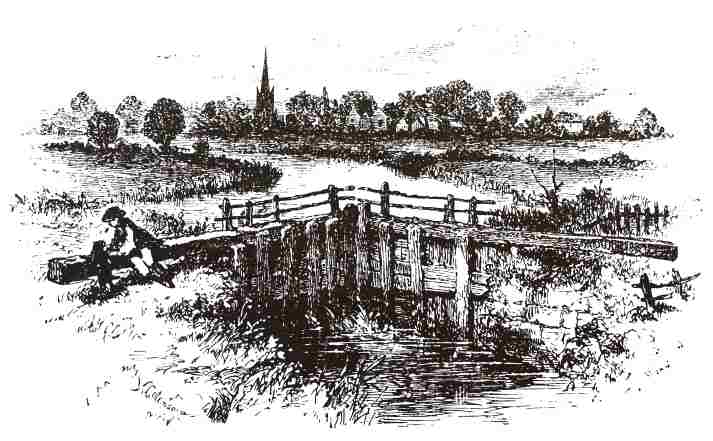
1857: The lock was “in a frightful state of
delapidation”; missing gates being replaced with hurdles and straw!
1859:-

St John’s Lock in 1859.
1867: Lock repaired.
1870: St John’s Lock, Henry Taunt -

St John’s Lock, Henry Taunt, 1870
© Oxfordshire County Council Photographic Archive; HT281
1885: The Royal River -
There are a lock house and garden to rest in, Thames Conservancy notices to be read,
and ancient lock-keeping folk to talk with.
It is a very old lock.
In the natural order of things it cannot last much longer, and at no distant date,
no doubt, it will give place to one of the more useful, but infinitely more prosaic,
affairs of iron, with modern improvements in the machinery,
which the Conservancy supplies when it is necessary to replace the original structures.
The partly-decayed boards, the hand-rail rising from their outer edge,
the lock gates patched many a time, and thinned in regard to their outer casing
by many a winter flood, have done their work, and stand in weather-worn picturesqueness,
all awry, doing their remaining duty as best they may.
[The rebuilding was still twenty years away!]
1885: St John’s Lock. It
is slightly worrying that the dog and owner who were at the lock in 1859, were still there in 1870
and 1885 -

St John’s Lock, 1885, the Royal River.
1905: Lock rebuilt.
A new lock house was built on the current site on the right bank – “a
picturesque new bungalow”
(Fred Thacker adds dryly “one hears regrets for the original shanty”.)
1923: Walter Higgins printed this in his book"Father Thames",
however it looks to me as if the print must be earlier than 1905 because there is
no sign of the new bungalow -

1923? St John’s Lock, Walter Higgins
1937:"The Thames and its Story" [ I think this counts as"regrets for the original shanty"! ] -
With its house and appurtenances, the lock makes a garish blot on the prevailing softness of colour:
it is all startingly new; the red brick and white paint have to be greatly toned down by time and weather
before they can take their proper place in the landscape.
But it will take years to accomplish, and one cannot but sigh for the picturesqueness of the old lock;
with its weather-worn boards, patched gates, and its pretty cottage,
it took its place comfortably in the scene.
The new building is aggressive; it suggests"hustle and bustle", and seems out of place
on the quiet banks of the soft flowing river.
But it is in accordance with the tendency of the times - a tendency to haste and utility,
at the sacrifice of beauty and leisure.
It is the day of the motor, and the river, almost as much as the roads, has been affected thereby.
These upper reaches, with the advent of the motor boat, have become easy of access to the tourist
whose desire it is to see all that is to be seen in the shortest possible time
with the least expenditure of trouble.
Hence the capture of the river by the motorist. But it must be said that the water motorist
is less unpleasant - save in his trail of petrol odour - than he of the car.
He makes no noise save the rhythmical beat of the screw,
and it must be acknowledged that there is even something fascinating in the smooth gliding of his boat.
We doubt, however, if the charm of the oar-propelled boat will be one whit lessened
to the real lovers of the river by the easier methods offered by the motor.
The delightful sense of healthy fatigue induced by a day's rowing is part of the pleasure
of the river-man; it accords fittingly with the closing in of the day,
when, the destination reached, oars are unshipped, the camp prepared, and the quietude of the summer night
settles down upon the scene, and the river with its gentle murmur provides a pleasant lullaby.
1955: St John’s Lock, Francis Frith -

1955: St John’s Lock, Francis Frith.
1960: St John’s Lock, Francis Frith -

1960: St John’s Lock, Francis Frith.
1992: Skyscan's Aerial view of St John’s Lock in The Secret Thames -

Skyscan's aerial view of St John's Lock.
2000: St John’s Lock -

St John's Lock.
So here then is the very shrine of Old
father Thames himself where he reclines in glory.
His effigy was carved by Rafaelle Monti, and
was originally displayed at the Great Exhibition at Crystal Palace
in 1851; unusually for its time, it was carved out of Portland cement.
It was rescued from the fire at Crystal Palace in 1936
and bought by the Thames Conservancy,
who eventually installed it at Thames Head in
1958. Following vandalism the statue was moved to St John's Lock from Thames
Head in 1974.
1994: Mollie Harris in 'The Stripling Thames' writes -
One man ... Eynsham born and bred is Ron May, who worked on the Thames
for thirty-two years. His father and his grandfather before him, too,
worked almost all their lives on the river.
His father, for some reason, was known as Soldier May and Ron always as Young Soldier.
At one time Ron was dredger-master and drove a hundred ton steam dredger,
which had to be towed up and down the river by a great tug.
...
It was Ron's gang who brought the huge figure of Old Father Thames
from the source at Trewsbury Mead to its present home at Lechlade.
One of their lorries had previously collected it from the Crystal Palace Exhibition
and had taken it to Trewsbury Mead years before.
So he was installed here at St John's Lock where the lock keeper can keep an eye on the old boy. (He does look as if he has, in the past, got up to quite a lot, and might just do so again, don't you think?)

Alexander Pope, celebrated the Peace brought about in 1713, and proclaims a new time of prosperity for the river -
In that blest moment, from his oozy bed
Old Father Thames advanced his reverend head;
His tresses dropped with dews, and o'er the stream
His shining horns diffused a golden gleam:
Graved on his urn appeared the moon, that guides
His swelling waters, and alternate tides;
The figured streams in waves of silver rolled,
And on their banks Augusta rose in gold.
Around his throne the sea-born brothers stood,
Who swell with tributary urns his flood;
First the famed authors of his ancient name,
The winding Isis and the fruitful Thame:
The Kennet swift, for silver eels renowned;
The Loddon slow, with verdant alders crowned;
Cole, whose dark streams his flowery islands lave;
And chalky Wey, that rolls a milky wave;
The blue, transparent Vandalis appears;
The gulfy Lee his sedgy tresses rears;
And sullen Mole, that hides his diving flood;
And silent Darent, stained with Danish blood.
High in the midst, upon his urn reclined,
(His sea-green mantle waving with the wind)
The god appeared: he turned his azure eyes
Where Windsor-domes and pompous turrets rise;
Then bowed and spoke; the winds forget to roar,
And the hushed waves glide softly to the shore.
"Hail, sacred Peace! hail, long-expected days,
That Thames's glory to the stars shall raise! ..."
I think old Father Thames really ought to find his home on Temple Island in the Henley reach – where he could supervise events more suited to his lascivious appearance. What am I talking about? Well look at a typical day for him …

Old father Thames.
There is another version of this print -

The Thames or the Triumph of navigation 1792, James Barry.
A typical scene at St John’s Lock …
The print goes with two couplets from the
poem 'Cooper's Hill' by Sir John Denham (1615-1669) -
Nor are his blessings to his banks confin'd,
But free and common as the sea or wind;
So that to us no thing, no place is strange,
While his fair bosom is the world's exchange.
I think what this is on about is the free market which the Thames facilitated
with its easy (well easier) means of commercial transport.
After Alexander Pope's celebration of the Great Peace under Queen Anne
this is just a little of a come down!
W Clark Russell -
Father Thames, once a god, might more fitly be termed a goddess, under the title of Commerce;
for this assuredly is the presiding spirit.
It quickens with life the smallest and craziest structures by the water-side;
the very ebb and flow of the noble stream seem obedient to its laws,
and its shadow is in the air and upon the face of the waters.
John Eade, with apologies to Lewis Carroll Listen to 'You are old, father Thames' -
"You are old, father Thames," the young man said,
"And your hair has become very white;
And yet you incessantly lounge on a bed -
Do you think, at your age, it is right?
"In my youth," father Thames replied to his son,
"I feared it might injure the brain;
But, being cement, I'm sure I have none,
So, I do it again and again."
"You are old," said the youth,"as I mentioned before,
And you have grown most uncommonly fat;
Yet were moved on for vandalism up at the source --
Pray what is the reason for that?"
"In my youth," said the sage, as he shook his grey locks,
"I kept all my limbs very supple
By the use of this paddle - and the throwing of rocks --
Allow me to shie you a couple?"
"You are old," said the youth,"and your jaws are too weak
For anything tougher than suet;
Yet you finished the goose, with the bones and the beak --
Pray, how did you manage to do it?"
"In my youth," said his father,"I took to the law,
And argued her name with wife Isis;
And the muscular strength, which it gave to my jaw,
Has brought me through many a crisis."
"You are old," said the youth,"one would hardly suppose
That your fame was as widespread as ever;
Yet you sit there in state and look down your nose --
What made you so awfully clever?"
"I have answered three questions, and that is enough,"
Father Thames says."Impertinent boaters!
Do you think I can listen all day to such stuff?
Be off, or they'll think you're all loafers."
St John’s Lock is the first on the Thames
and still has its manual, wheel operated, paddles.
If you have to do it yourself it is a delight
in comparison with the average canal lock.
The weir here is often the first to trigger the adjustment of all the weirs down the river. When the lock keeper sees a change in level he
responds appropriately and then telephones the next lock down - so that a movement here can cause a ripple effect all the way down.
Above the lock there are a few more
tentative meanders. Father Thames was
just practising for the full grown article below the lock. So we zigzag across the field, past the
school to Lechlade Reach which is usually lined with temporarily moored boats
on the field side and on the other a tree lined bank and glimpses of Lechlade
town and church.
1937:"The Thames and its Story" -
The river is very modest hereabouts; at its widest part, in the near neighbourhood of the lock,
it is not more than twenty yards across from bank to bank - a silver ribbon in the green
meadows with which it is bordered on either side.
The scene is a peculiarly English one ... the red-tiled village, the grey church and bridge,
framed in the rich green foliage; the verdant meadow lands surrounded again with trees,
form a picture which is ever pleasing.

Aerial view above St John's Lock

The River Thames near Lechlade, Ashley Bryant
Height profile of the Thames. Cursor over each section for details.
|
Lechlade - - - - - - - - - - - - Oxford - - - - - - - - - - - - - Goring - - - - - - - - - - Henley - - - - - - - Windsor - - - - - - Teddington 73.1m - - - - - - - - - - - - - - - - - - - - - - - - Height above sea level- - - - - - - - - - - - - - - - - - - - - - - - - - - - - - - - - - 4.3m |
(Upstream to Halfpenny Bridge)
Introduction
Estuary
PLA
QEII Br
Barrier
Tower Br
Custom Ho
London Br
; Frost Fairs
Cannon St Rb
The Great Stink
Southwark Br
Millenium Br
Blackfriars Rb
Blackfriars Br
Waterloo Br
Charing Cross Rb
Westminster Br
Lambeth Br
Vauxhall Br
Victoria Rb
Chelsea Br
Albert Br
Battersea Br
Battersea Rb
Wandsworth Br
Fulham Rb
Putney Br
Hammersmith Br
Barnes Rb
Chiswick Br
Kew Rb
Kew Br
RICHMOND
Twickenham Br
Richmond Rb
Richmond Br
TEDDINGTON
Kingston Rb
Kingston Br
Ditton Slip
Hampton Br
MOLESEY
SUNBURY
Walton Br
Desborough Cut
SHEPPERTON
Chertsey Br
CHERTSEY
M3 Br
Laleham Slip
PENTON HOOK
Staines Rb
Staines Br
Runnymede Br
BELL WEIR
Magna Carta Is
OLD WINDSOR
Albert Br
Datchet
Victoria Br
Black Potts Rb
ROMNEY
Eton
Windsor Br
Windsor Rb
Windsor Slip
Elizabeth Br
BOVENEY
Dorney Lake
York Cut
Summerleaze Fb
MonkeyIsland
New Thames Br
BRAY
Bray Slip
Maidenhead Rb
Maidenhead Br
Below Boulters
BOULTERS
Cliveden
Hedsor
COOKHAM
Cookham Slip
Cookham Br
BourneEnd RFb
Quarry Woods
A404 Br
MARLOW
Marlow Br
Bisham
TEMPLE
HURLEY
Medmenham
Culham Ct
Aston Slip
HAMBLEDEN
Temple Is
Fawley Ct
Remenham
Regatta
Phyllis Ct
Henley Slip
Leander
Red Lion
Henley Br
Angel on Br
Landing
Hobbs Boatyard
Hobbs Slipway
MARSH
Hennerton
Bolney
Wargrave
Shiplake Rb
R.Loddon
SHIPLAKE
Sonning Br
SONNING
Dreadnought
K&A Canal
CAVERSHAM
Reading Br
Caversham Br
Reading Slip
Purley
MAPLEDURHAM
Hardwick Ho
Whitchurch Br
WHITCHURCH
Hartswood Reach
Gatehampton Rb
Goring Gap
Goring Br
GORING
Swan
CLEEVE
Moulsford
Moulsford Rb
Papist Way Slip
Winterbrook Br
Wallingford Br
BENSON
Shillingford Br
R.Thame
DAYS
Burcot
Clifton Hampden
Clifton Church
Clifton H Br
Barley Mow
Long Wittenham
CLIFTON
Appleford Rb
Sutton Courtenay
Sutton Br
CULHAM
Culham Cut Fb
Abingdon Slip
Abingdon
Abingdon Br
ABINGDON
Nuneham Rb
Nuneham
Nuneham Park
Radley Boats
SANDFORD
Rose Island
Kennington Rb
Isis Br
Iffley Mill
IFFLEY
Oxford Rowing
Isis
Donnington Br
Riverside Slip
Boathouses
Punting
Lower Cherwell
Upper Cherwell
Islip
Head of River
Salters Steamers
Folly Br
Bacons Folly
Oxford Fb
Osney Fb
Weir stream
Osney Rb
Bullstake Stream
Osney Marina
OSNEY
Osney Br
Four Rivers
OLD RIVER
CANAL
Medley Weir Site
Medley Fb
Bossoms
Perch
Trout
GODSTOW
Godstow Nunnery
Godstow Br
Thames Br
KINGS
River Evenlode
EYNSHAM
Swinford Br
Oxford Cruisers
PINKHILL
Farmoor
Stanton Harcourt
Bablock Slip
Arks Weir Site
NORTHMOOR
Harts Fb
Rose Revived
Newbridge
Maybush
River Windrush
below Shifford
SHIFFORD
Shifford Fb
Tenfoot Fb
Trout Inn
Tadpole Br
RUSHEY
Old Mans Fb
RADCOT
Radcot Cradle Fb
Swan Inn
Radcot New Br
Radcot Old Br
GRAFTON
Eaton Hastings
Kelmscott
Eaton Fb
BUSCOT
Bloomers Hole Fb
Trout Inn
St Johns Br
ST JOHNS
Halfpenny Br
Marina Slip
LIMIT
Inglesham
Hannington Br
Kempsford
Castle Eaton Br
Marston Meysey
A419 Br
Cricklade
SOURCE?
THAMES HEAD
SEVEN SPRINGS